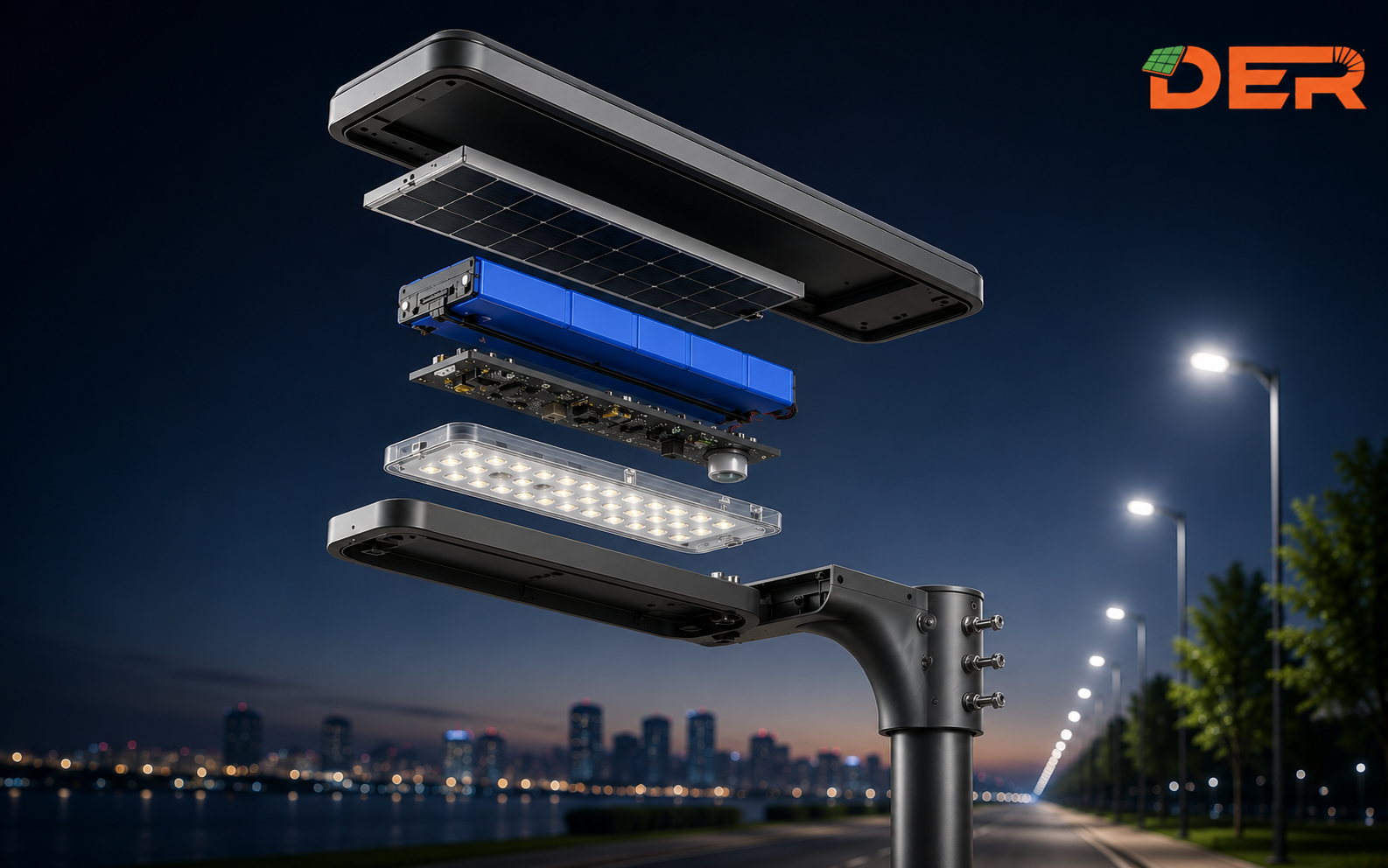
Every all in one solar street light combines several essential components into a single integrated unit. The solar panel, lithium battery, LED module, solar charge controller, sensors, housing, and mounting system each play a specific role in determining the light’s efficiency, reliability, and service life.
Understanding how these components work and what separates high-quality components from inferior ones helps buyers compare products, evaluate suppliers, and make more informed purchasing decisions.
This guide explains each component in detail and highlights the key factors to consider before buying.
Quick Components List
| Component | Primary Function |
| Solar Panel | Converts sunlight into electricity to charge the battery. |
| Battery | Stores solar energy for nighttime operation. |
| LED Lighting Module | Produces illumination using stored electrical energy. |
| Solar Charge Controller | Regulates charging, discharging, and power management. |
| Sensors and Smart Controls | Enable automatic operation, dimming, and energy optimization. |
| Housing and Structural Components | Protect internal components and dissipate heat. |
| Mounting System and Pole Interface | Secures the fixture to the pole for safe installation. |
| Internal Wiring and Electrical Connections | Connect all components and ensure reliable electrical performance. |
What Components Make Up an All-in-One Solar Street Light?
Every all in one led solar street light is built from seven core systems working together. These are the solar panel, the battery, the LED lighting module, the solar charge controller, sensors and smart controls, the housing, and the mounting system.
Each component directly affects performance, lifespan, and total cost of ownership.
Solar Panel: The System’s Power Source
The solar panel converts sunlight into electricity through the photovoltaic effect. Solar cells inside the photovoltaic (PV) module absorb solar irradiance and generate direct current, which is then sent to the solar charge controller to charge the battery.
Monocrystalline vs. Polycrystalline Solar Panels
All in one solar street lights typically use either monocrystalline or polycrystalline solar panels.
Monocrystalline panels offer higher conversion efficiency and better performance in limited installation space, making them the preferred choice for most modern integrated lighting systems.
Polycrystalline panels are generally more affordable but produce less power from the same surface area.
Battery: The Energy Storage System
The battery stores the electricity generated by the solar panel and supplies power to the LED module after sunset. Its capacity, cycle life, and overall quality directly affect runtime, lighting autonomy, and long-term reliability.
Common Battery Technologies
Modern all in one solar street lights typically use lithium iron phosphate (LiFePO₄) or lithium-ion batteries. LiFePO₄ batteries are generally preferred because they offer a longer service life, better thermal stability, and greater resistance to deep discharge.
Although lithium-ion batteries provide high energy density, they are typically more sensitive to extreme temperatures. Lead-acid batteries are now rarely used because they are heavier, have shorter cycle lives, and require more maintenance.
Battery Capacity and Autonomy
Battery capacity determines how long the light can operate at night and during periods of limited sunlight. Greater lighting autonomy allows the system to continue operating through multiple cloudy days without recharging.
Factors That Affect Battery Life
Battery lifespan is influenced by depth of discharge (DoD), operating temperature, battery protection features, and the effectiveness of the Battery Management System (BMS).
3. LED Lighting Module: Turning Energy into Light
The LED module converts stored electrical energy into visible light. Its performance depends on the LED chip quality, the optical lens design, and the overall thermal management of the fixture.
Key Components of an LED Module
An LED module typically includes the LED chip, a driver circuit, an optical lens for light distribution, and a heat sink to manage heat dissipation.
LED Performance and Light Distribution
The quality of the LED chip directly affects luminous efficacy, which is the amount of light produced per watt of energy consumed.
High-quality LED chips commonly achieve between 160 and 220 lumens per watt, improving lighting efficiency while extending battery runtime.
Light distribution depends on the beam angle and optical lens design. A wider beam angle spreads light over a larger area, while a narrower beam concentrates illumination on a smaller zone. Selecting the appropriate beam pattern helps achieve uniform lighting for different urban roads and commercial applications.
4. Solar Charge Controller: The System’s Brain
The solar charge controller regulates how electricity flows between the solar panel, the battery, and the LED module. It manages charging algorithms, prevents overcharge protection failures, and controls power management functions like dusk-to-dawn operation.
MPPT vs. PWM Controllers
Maximum Power Point Tracking (MPPT) is a charging technology that continuously adjusts the electrical operating point of a solar panel to harvest the maximum available energy under changing sunlight conditions.
Pulse Width Modulation (PWM) controllers are simpler and less expensive, but they are less efficient at converting solar energy, especially in cloudy or low-light conditions. MPPT controllers generally deliver 20 to 30 percent higher charging efficiency than PWM controllers.
Battery Protection Functions
A quality controller includes overcharge protection, deep discharge protection, and temperature compensation to extend battery cycle life and prevent premature failure.
Intelligent Energy Management
Intelligent controllers adjust brightness and power output based on motion sensing, time of night, and remaining battery capacity, which helps balance lighting efficiency with backup time.
5. Sensors and Smart Controls
PIR Motion Sensors
PIR motion sensors detect movement using infrared heat signatures and trigger the LED to brighten when a person or vehicle approaches, then dim again after a set period.
Microwave Motion Sensors
Microwave sensors detect motion using radio waves and can sense movement through some obstructions, offering a wider detection range than PIR sensors in certain conditions.
Light Sensors
A light sensor, also called a photocell, enables automatic on/off and dusk-to-dawn operation by detecting ambient light levels and switching the LED on at sunset and off at sunrise.
Smart Lighting Profiles
Intelligent dimming profiles allow the light to run at full brightness during peak hours and reduce power consumption during low-traffic periods, extending autonomy.
Optional Remote Monitoring (RMS/IoT)
Some all in one solar street light manufacturer product lines include remote monitoring systems that report battery status, faults, and performance data, which is useful for large-scale municipal or commercial projects.
6. Housing and Structural Components
The housing protects internal electronics from water, dust, corrosion, and physical impact. Poor housing quality is one of the leading causes of premature product failure.
Die-Cast Aluminum Housing
Aluminum housing, often made from die-cast aluminum alloy, offers strong corrosion resistance and efficient heat dissipation compared to plastic enclosures.
Heat Dissipation
Effective thermal management through the heat sink and housing design prevents the LED chip and battery from overheating, which preserves long-term performance and LED lifespan.
Waterproof and Dustproof Protection – What does IP66 mean?
IP66 means the fixture is dust-tight and protected against powerful water jets from any direction. IP65 offers slightly less protection against high-pressure water but still provides a dustproof enclosure suitable for most outdoor environments.
Wind Resistance and Structural Durability
Quality housing and mounting brackets should be rated for wind resistance appropriate to the installation region, along with salt corrosion resistance for coastal projects.
7. Mounting System and Pole Interface
A reliable mounting system keeps the fixture securely attached to the pole while ensuring the solar panel and LED module are positioned for optimal performance. The bracket design also affects installation speed, compatibility, and long-term stability.
Mounting Brackets
Mounting brackets secure the all in one solar street light fixture to the pole and are typically made from aluminum alloy or stainless steel fasteners to provide long-term corrosion resistance.
Adjustable Mounting Angles
Many brackets allow installers to adjust the fixture’s tilt angle. Proper adjustment helps maximize solar charging efficiency while directing light where it is needed most.
Pole Compatibility
The mounting bracket must match the pole diameter to ensure a secure installation. Most manufacturers offer brackets designed for round poles with diameters between 60 mm and 100 mm.
Installation Considerations
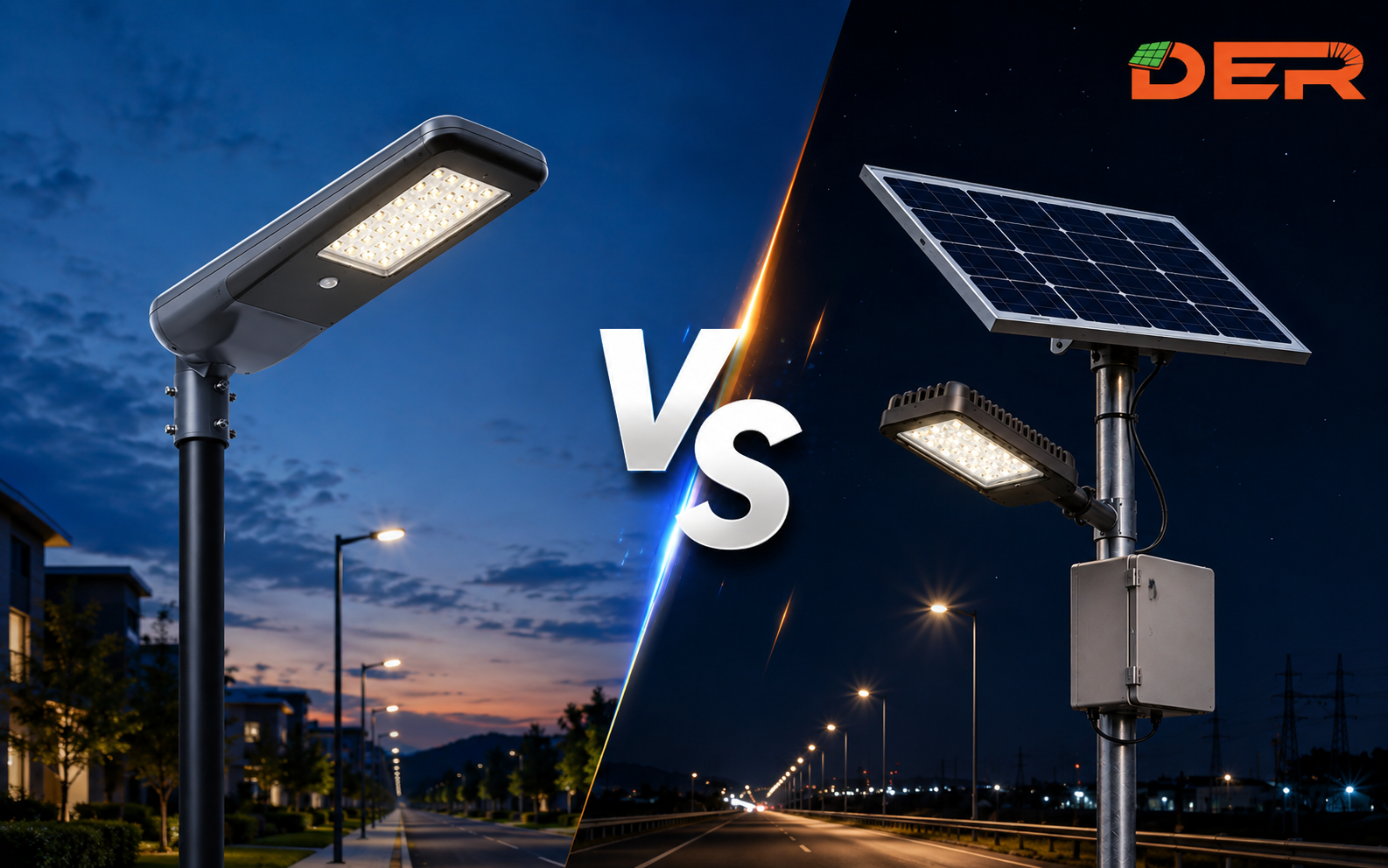
Because all major components are integrated into a single fixture, installation is faster and requires no trenching or interconnecting cables. This simplified installation is one of the primary advantages of an all in one solar street light compared with split-type systems.
8. Internal Wiring and Electrical Connections
Connectors and Internal Cables
Internal wiring connects the solar panel, battery, controller, and LED module. Waterproof connectors prevent moisture ingress at each connection point.
Waterproof Sealing
Silicone gaskets and sealed connector housings protect wiring from water damage, which is critical since these connections sit inside a sealed, largely inaccessible enclosure.
Corrosion Protection
Corrosion-resistant wiring and connectors extend service life, particularly in coastal or high-humidity regions where salt corrosion resistance becomes a priority.
Manufacturing Quality
Factory assembly quality determines how consistently these internal connections perform over years of outdoor exposure.
Manufacturers with strong OEM and ODM manufacturing capabilities can maintain tighter quality control throughout the production process, resulting in more consistent product quality and reliability.
Poor manufacturing quality at this stage often leads to early failures that are difficult to diagnose or repair in the field.
How All Components Work Together
The solar panel captures solar energy during the day and sends it through the charge controller to the battery. The controller regulates battery charging and prevents overcharge or deep discharge.
At night, the light sensor triggers automatic on/off operation, the motion sensor adjusts brightness based on activity, and the LED module converts stored energy into usable light.
This integrated design is what defines an all in one solar street light and separates it from split-type systems.
Which Components Have the Biggest Impact on Performance?
Battery capacity, solar panel efficiency, and LED chip quality have the greatest impact on overall performance. The table below summarizes their role.
| Component | Primary Impact | Key Metric |
| Solar Panel | Charging efficiency | Conversion efficiency (%) |
| Battery | Runtime and autonomy | Capacity (Ah) and cycle life |
| LED Chip | Light output | Luminous efficacy (lm/W) |
| Controller | Energy management | MPPT vs PWM efficiency |
How Component Quality Affects Total Cost of Ownership (TCO)
Lithium batteries typically cost more upfront than lead-acid alternatives, but they last significantly longer because they tolerate deeper discharge cycles and higher charging efficiency.
This lowers replacement cost over the product’s lifespan. Higher build quality components also reduce maintenance requirements, which matters for large-scale deployments where field service is expensive and time-consuming.
Common Mistakes Buyers Make When Evaluating Components
- Focusing only on wattage instead of luminous efficacy
- Ignoring battery cycle life and depth of discharge ratings
- Choosing PWM controllers for projects that need higher charging efficiency
- Overlooking IP rating and IK rating for outdoor durability
- Not verifying pole compatibility before ordering brackets
Choose an All-in-One Solar Street Light Built with Quality Components
The quality of an all in one solar street light depends on more than its specifications. High-performance solar panels, long-lasting LiFePO₄ batteries, efficient LED modules, intelligent MPPT controllers, and durable aluminum housings all contribute to reliable operation and a lower total cost of ownership.
At DER Lighting, we design and manufacture all in one solar street lights using carefully selected components that deliver consistent performance across residential, commercial, and infrastructure projects. Whether you’re sourcing products for distribution, wholesale, or an upcoming project, our team can help you find the right solution for your requirements.
Contact DER Lighting today to discuss your project or request more information about our all in one solar street light product range.
Conclusion
The performance of an all in one solar street light depends on the quality of its core components, including the solar panel, lithium battery, LED module, charge controller, sensors, and housing.
Understanding how these components work together helps buyers compare products, evaluate suppliers, and select solutions that deliver reliable performance, longer service life, and lower total cost of ownership for their specific project requirements.
Frequently Asked Questions (FAQs):
The main components are the solar panel, lithium battery, LED module, solar charge controller, sensors, housing, and mounting system. These components work together to generate, store, and use solar energy for outdoor lighting.
Most modern all in one solar street lights use lithium iron phosphate (LiFePO₄) batteries. They offer a longer lifespan, better thermal stability, and improved performance compared to traditional lead-acid batteries.
An MPPT controller adjusts charging based on available sunlight to maximize energy harvest. This generally provides higher charging efficiency than a PWM controller, especially in changing weather conditions.
The housing protects internal components from dust, water, corrosion, and physical damage. A durable aluminum housing also helps dissipate heat, which can improve the lifespan of the LED module and battery.
The solar panel, battery, LED module, and charge controller have the greatest influence on overall performance. Their quality affects charging efficiency, lighting runtime, energy management, and long-term reliability.