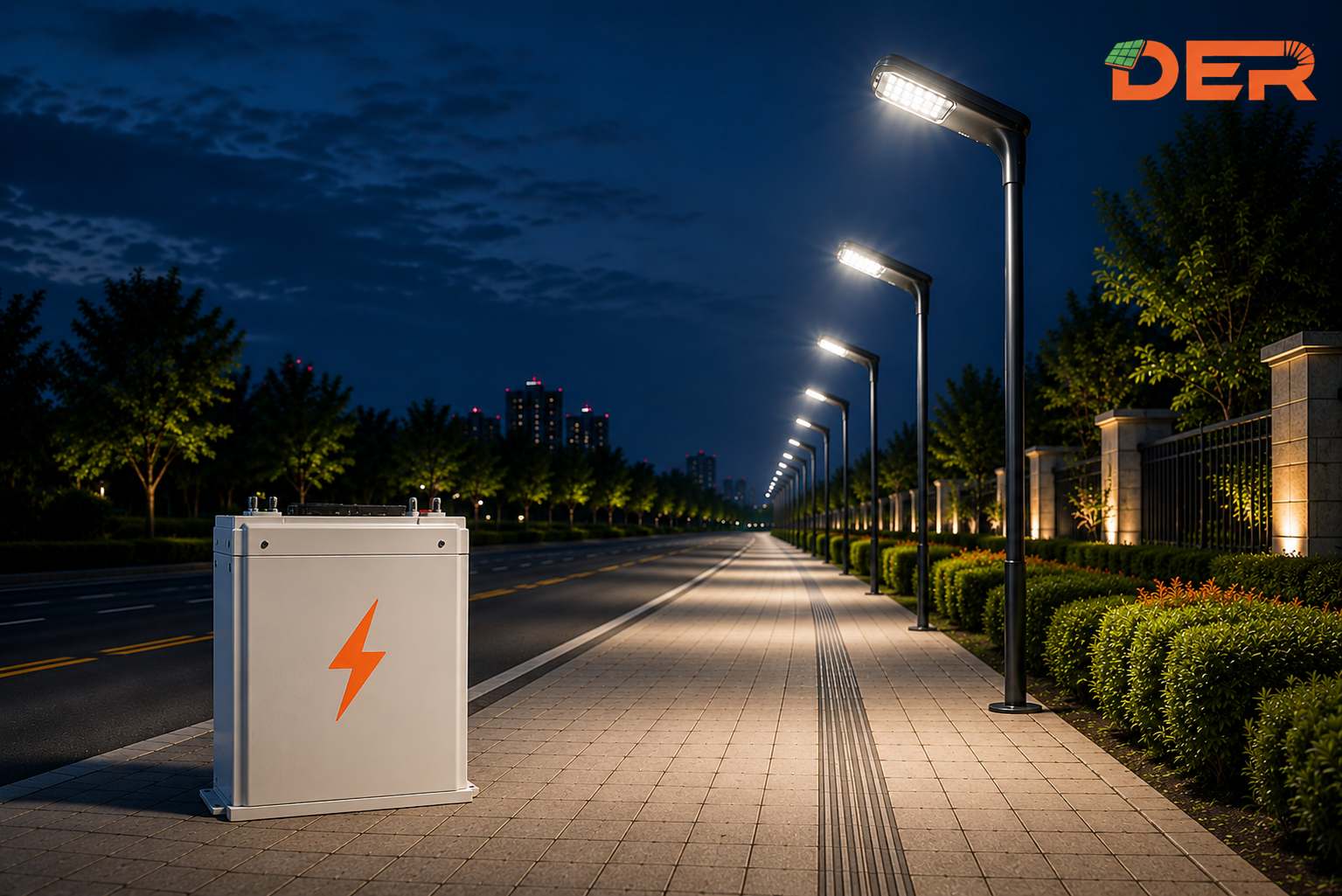
The lithium battery is the component that determines whether an all in one solar street light performs reliably or fails within a few years. It stores the energy collected by the solar panel during the day and releases it to power the LED lamp at night.
Most reliable manufacturers of all in one solar street lights now use Lithium Iron Phosphate (LiFePO₄) battery packs because they offer longer cycle life, better thermal stability, and lower maintenance than older battery chemistries.
This article explains how lithium batteries affect performance, what specifications matter most, and what buyers should evaluate before choosing an all in one solar street light.
Key Takeaways
- LiFePO₄ batteries are the standard choice for all-in-one solar street lights due to long cycle life and thermal stability.
- Battery capacity and depth of discharge directly determine runtime and autonomy during cloudy weather.
- A quality Battery Management System protects cells and extends overall battery lifespan.
- Comparing Ah, Wh, cycle life, and DoD gives a clearer performance picture than wattage alone.
- Proper system integration between the battery, solar panel, and LED driver affects real-world reliability.
Why Are Lithium Batteries So Important in All-in-One Solar Street Lights?
The lithium battery plays a central role in determining the runtime, brightness stability, and reliability of an all in one solar street light during cloudy weather.
Because an all in one integrated solar street light has no external wiring or backup power source, the battery pack alone determines nighttime reliability.
A weak or poorly matched battery leads to dim output, shortened runtime, and premature failure, even if the solar panel and LED driver are high quality.
What Does a Lithium Battery Do in an All in One Solar Street Light?
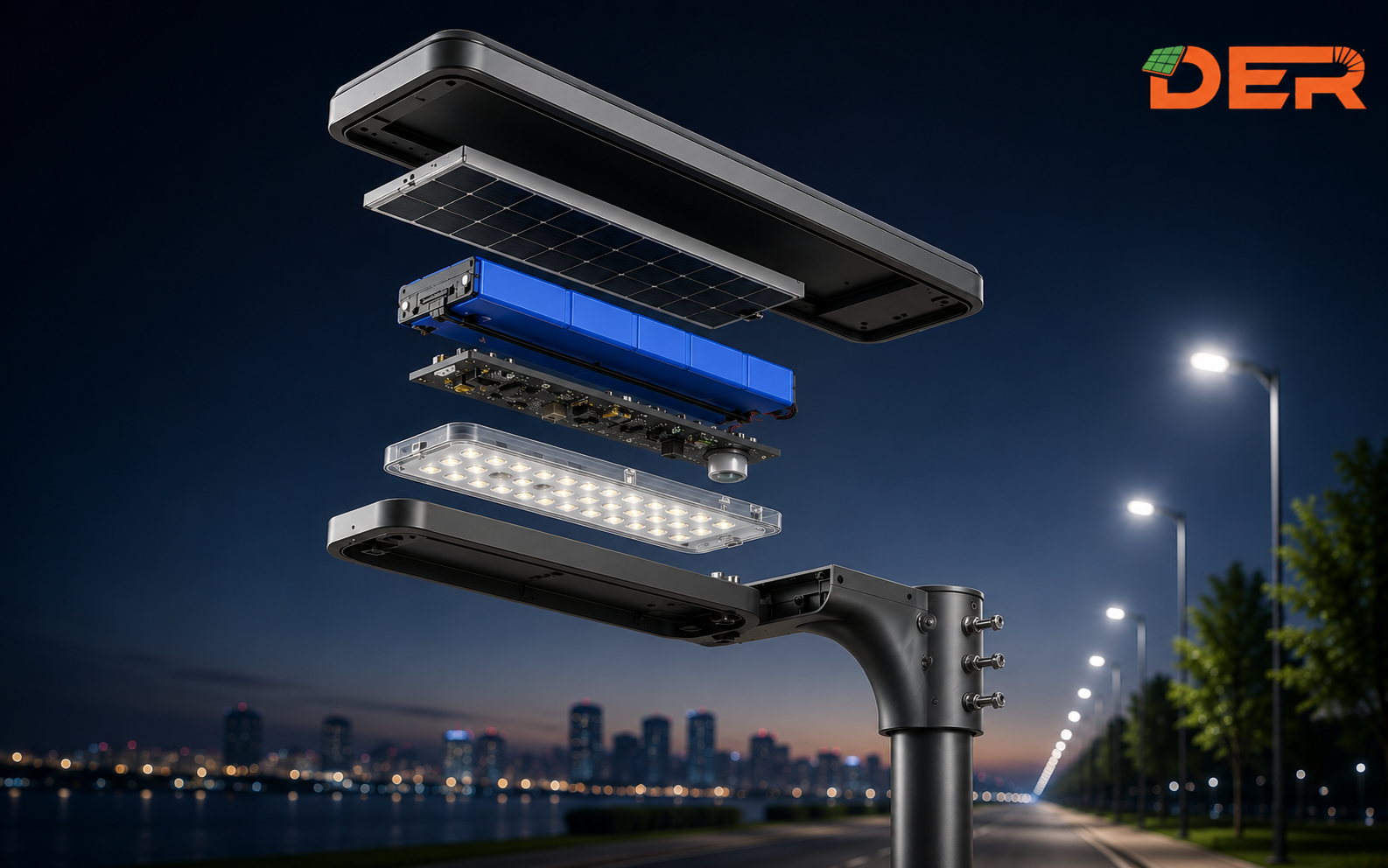
The lithium battery stores electricity generated by the solar panel during daylight hours. At night, it discharges that stored energy through the charge controller to power the LED chip.
The battery also works with the Battery Management System (BMS) to regulate voltage, monitor temperature, and protect the cells from overcharging or deep discharge.
Why Do Most All in One Solar Street Lights Use LiFePO₄ Batteries?
LiFePO₄ (Lithium Iron Phosphate) batteries are the preferred energy storage solution for most all in one solar street lights because they offer a long cycle life, excellent thermal stability, and a high level of safety.
These characteristics enable reliable outdoor performance, low maintenance, and a longer service life, making LiFePO₄ well suited for lighting systems that operate unattended in diverse weather conditions.
Longer Service Life
LiFePO₄ batteries typically deliver 2,000 to 6,000 charge cycles before capacity drops below usable levels. A standard lead-acid battery usually lasts 300 to 500 cycles.
This difference means a LiFePO₄ battery pack can outlast several lead-acid replacements over the same period, reducing long-term maintenance costs.
Higher Safety and Thermal Stability
LiFePO₄ cells resist thermal runaway better than other lithium-ion chemistries because the iron phosphate structure stays chemically stable at higher temperatures. This makes LiFePO₄ a safer choice for outdoor fixtures exposed to direct sun and seasonal heat.
Higher Charging and Discharging Efficiency
LiFePO₄ batteries typically achieve charge and discharge efficiency above 95 percent. Higher round-trip efficiency means less energy is lost during the daily charge and discharge cycle, which improves overall system performance.
Low Maintenance Requirements
LiFePO₄ batteries do not require water top-ups, equalization charging, or the periodic maintenance associated with lead-acid or AGM batteries. This lowers the total cost of ownership for large-scale solar lighting projects.
How Do Lithium Batteries Affect the Performance of an All in One Solar Street Light?
Battery performance directly shapes runtime, brightness stability, and how the light behaves during extended cloudy periods. These outcomes depend on battery capacity, energy density, and how well the Battery Management System regulates charging and discharging.
Runtime and Nighttime Operating Hours
Runtime refers to how many hours the light can operate on a single full charge. A battery with higher capacity, measured in ampere-hours (Ah) or watt-hours (Wh), generally supports longer nighttime operation.
Runtime also depends on LED wattage, dimming settings, and motion sensor activity.
Brightness Stability Throughout the Night
A well-designed lithium battery pack maintains stable voltage output as it discharges, which keeps brightness consistent from dusk until dawn. Batteries with poor internal resistance control tend to show voltage sag, causing the light to dim noticeably before the battery is fully depleted.
Performance During Consecutive Cloudy Days
Autonomy describes how many cloudy days the light can operate without fresh solar charging. Higher battery capacity and efficient charge management extend autonomy, allowing the fixture to maintain acceptable brightness during several consecutive cloudy days.
Long-Term Reliability and Service Life
Battery lifespan and capacity retention determine how consistently the light performs after years of daily charge cycles. A high-quality LiFePO₄ battery pack retains more of its original capacity after thousands of cycles compared to lower-grade lithium or lead-acid alternatives.
What Battery Specifications Matter Most When Evaluating Performance?
Buyers evaluating an all in one solar street light manufacturer should compare battery capacity, energy density, cycle life, depth of discharge, and charging efficiency side by side, since these specifications determine real-world performance more accurately than headline wattage claims.
Battery Capacity (Ah vs. Wh)
Battery capacity is usually listed in ampere-hours (Ah) or watt-hours (Wh). Watt-hours give a more complete picture because they account for both voltage and current, making it easier to compare batteries with different nominal voltages.
Energy Density
Energy density describes how much energy a battery stores relative to its size or weight. Higher specific energy allows manufacturers to fit more capacity into a compact all in one solar street light pole housing without increasing bulk.
Cycle Life
Cycle life indicates how many complete charge cycles a battery can handle before its capacity drops to around 80 percent of the original rating. LiFePO₄ batteries generally offer significantly higher cycle life than lead-acid or AGM alternatives.
Depth of Discharge (DoD)
Depth of Discharge (DoD) refers to how much of the battery’s total capacity is used before recharging. LiFePO₄ batteries tolerate deep discharge, often operating safely at 80 to 100 percent DoD, while lead-acid batteries degrade quickly if discharged beyond 50 percent.
Charging and Discharging Efficiency
Charge efficiency and discharge efficiency together determine round-trip efficiency, or how much usable energy is returned compared to what was originally stored. Higher efficiency reduces energy waste and supports more consistent nighttime performance.
What Factors Affect the Lifespan of Lithium Batteries?
Battery lifespan depends on operating temperature, depth of discharge, charging conditions, and overall battery quality. Understanding these factors helps buyers set realistic expectations for long-term performance.
Operating Temperature
Lithium batteries degrade faster at extreme temperatures. High-temperature performance issues accelerate capacity loss, while low-temperature performance issues can reduce available capacity temporarily.
LiFePO₄ batteries handle a wider operating temperature range than most lithium-ion alternatives.
Depth of Discharge
Consistently discharging a battery to a very low state of charge shortens its usable lifespan. Keeping depth of discharge within recommended limits helps preserve cycle life and overall battery health.
Charging and Discharging Conditions
Fast charging at inappropriate temperatures can cause lithium plating, which permanently reduces capacity. A well-designed charge controller and BMS prevent this by managing charging temperature and current within safe limits.
Battery Quality
Battery cell quality varies significantly between manufacturers and depends on their manufacturing quality and quality control processes.
Higher-grade cells maintain better capacity retention and internal resistance stability over thousands of charge cycles, directly affecting long-term reliability.
How Does a Battery Management System (BMS) Extend Battery Life?
A Battery Management System (BMS) is an electronic control system that monitors and protects a lithium battery by regulating its voltage, temperature, and state of charge (SoC).
By preventing overcharging, over-discharging, overheating, and cell imbalance, a BMS helps extend battery lifespan while improving the safety and reliability of an all in one solar street light.
How Do LiFePO₄ Batteries Compare with Other Solar Street Light Battery Types?
LiFePO₄ batteries outperform most alternatives across cycle life, safety, and maintenance, though they typically cost more upfront than lead-acid options.
| Feature | LiFePO₄ | Lead-Acid | AGM/Gel |
| Cycle Life | 2,000–6,000 | 300–500 | 400–600 |
| Depth of Discharge | 80–100% | Up to 50% | Up to 50% |
| Thermal Stability | High | Moderate | Moderate |
| Maintenance | Minimal | Regular | Low to moderate |
| Weight | Lighter | Heavier | Heavier |
| Upfront Cost | Higher | Lower | Moderate |
For importers and distributors, this comparison shows why LiFePO₄ has become the standard chemistry for a modern all in one integrated solar street light, despite a higher initial price.
What Should Buyers Look for in the Battery of an All in One Solar Street Light?
Buyers should evaluate battery chemistry, capacity, cycle life, BMS quality, temperature range, and how well the battery integrates with the rest of the system.
Battery Chemistry
Confirm whether the product uses LiFePO₄ or another lithium-ion chemistry. LiFePO₄ is generally the safer and longer-lasting choice for outdoor applications.
Battery Capacity
Match battery capacity, in Ah or Wh, to the required runtime and local sunshine hours. Projects in regions with fewer sunny days need higher capacity to maintain autonomy.
Cycle Life
Ask manufacturers for tested cycle life data rather than relying on general chemistry claims, since cell quality affects actual performance.
Battery Management System (BMS)
Verify that the BMS includes overcharge protection, over-discharge protection, short-circuit protection, and temperature monitoring, since these features directly affect battery lifespan.
Operating Temperature Range
Check the battery’s rated operating temperature range against the climate of the installation site, particularly for regions with extreme heat or cold.
System Design and Battery Integration
Evaluate how the battery pack, solar panel, charge controller, and LED driver work together within the integrated design. Poor integration between components can undermine even a high-quality battery.
Choose an All in One Solar Street Light with the Right Lithium Battery
The quality of the lithium battery has a direct impact on the performance, reliability, and lifespan of an all in one solar street light.
A well-designed battery system delivers consistent brightness, longer runtime, and dependable operation in varying weather conditions while reducing long-term maintenance. Explore DER Lighting’s range of all in one solar street lights or contact our team to find the right solution for your project requirements.
Conclusion
The lithium battery is the core component that determines the long-term performance of an all in one solar street light. It influences runtime, brightness stability, reliability, and operation during cloudy weather, while the Battery Management System helps protect battery health and extend service life.
When comparing products, buyers should look beyond price and evaluate battery chemistry, capacity, cycle life, and BMS quality to make a well-informed decision.
Frequently Asked Questions (FAQs)
Yes. Batteries store the energy generated during the day and power the LED light at night. Without a battery, a solar street light cannot operate after sunset.
LiFePO₄ (Lithium Iron Phosphate) batteries are the preferred choice because they offer a long cycle life, high safety, excellent thermal stability, and low maintenance.
Yes. Most all in one solar street lights allow the lithium battery to be replaced when it reaches the end of its service life. The replacement battery should match the original specifications for safe and reliable operation.
Ampere-hours (Ah) measure battery charge, while watt-hours (Wh) measure total stored energy. Wh provides a more accurate comparison between batteries with different voltages.
Battery capacity affects runtime, but overall performance also depends on battery chemistry, cycle life, charging efficiency, the Battery Management System (BMS), and overall system design.
Yes. LiFePO₄ batteries offer excellent thermal stability and are highly resistant to overheating, making them one of the safest battery chemistries for outdoor solar street lights.