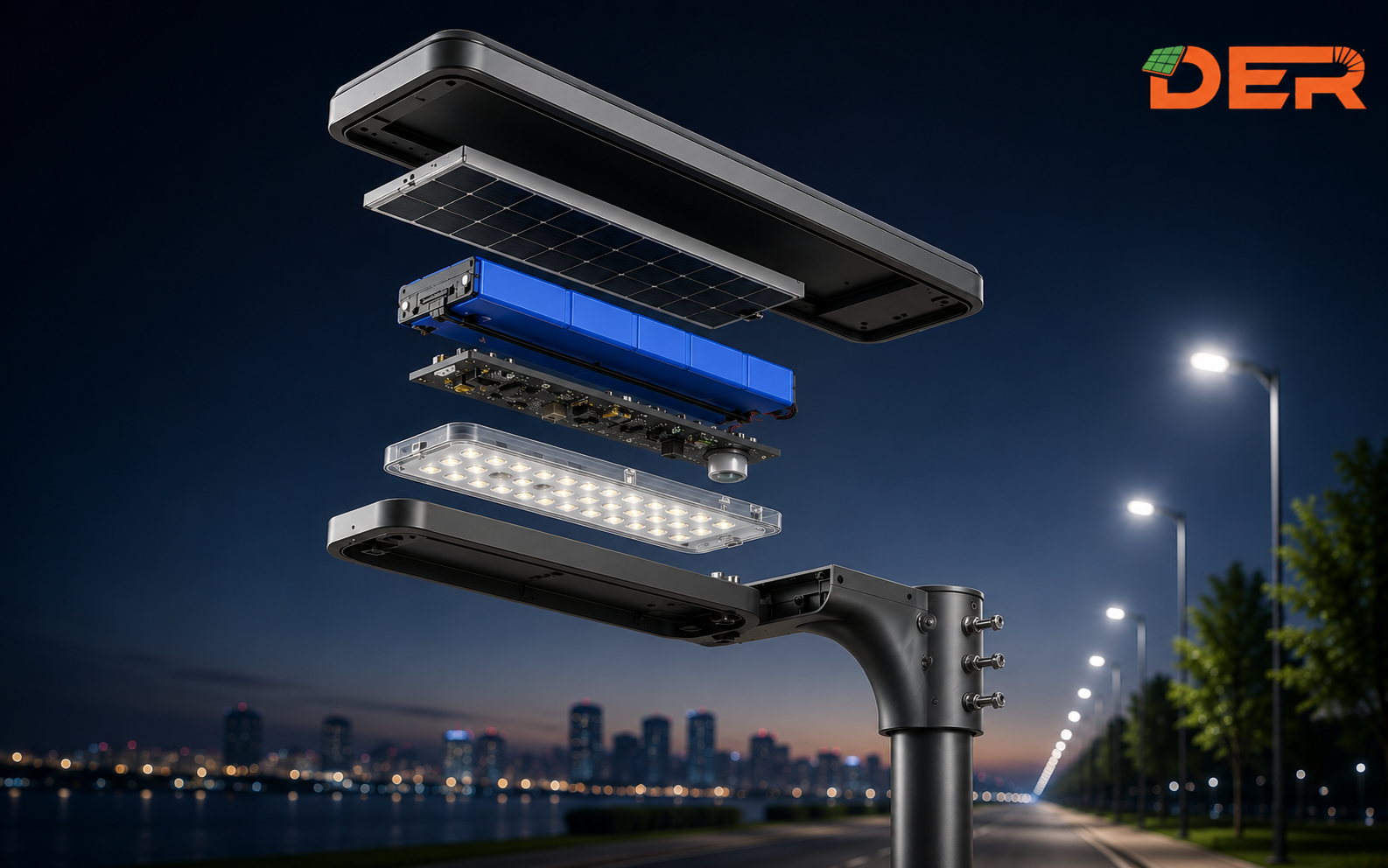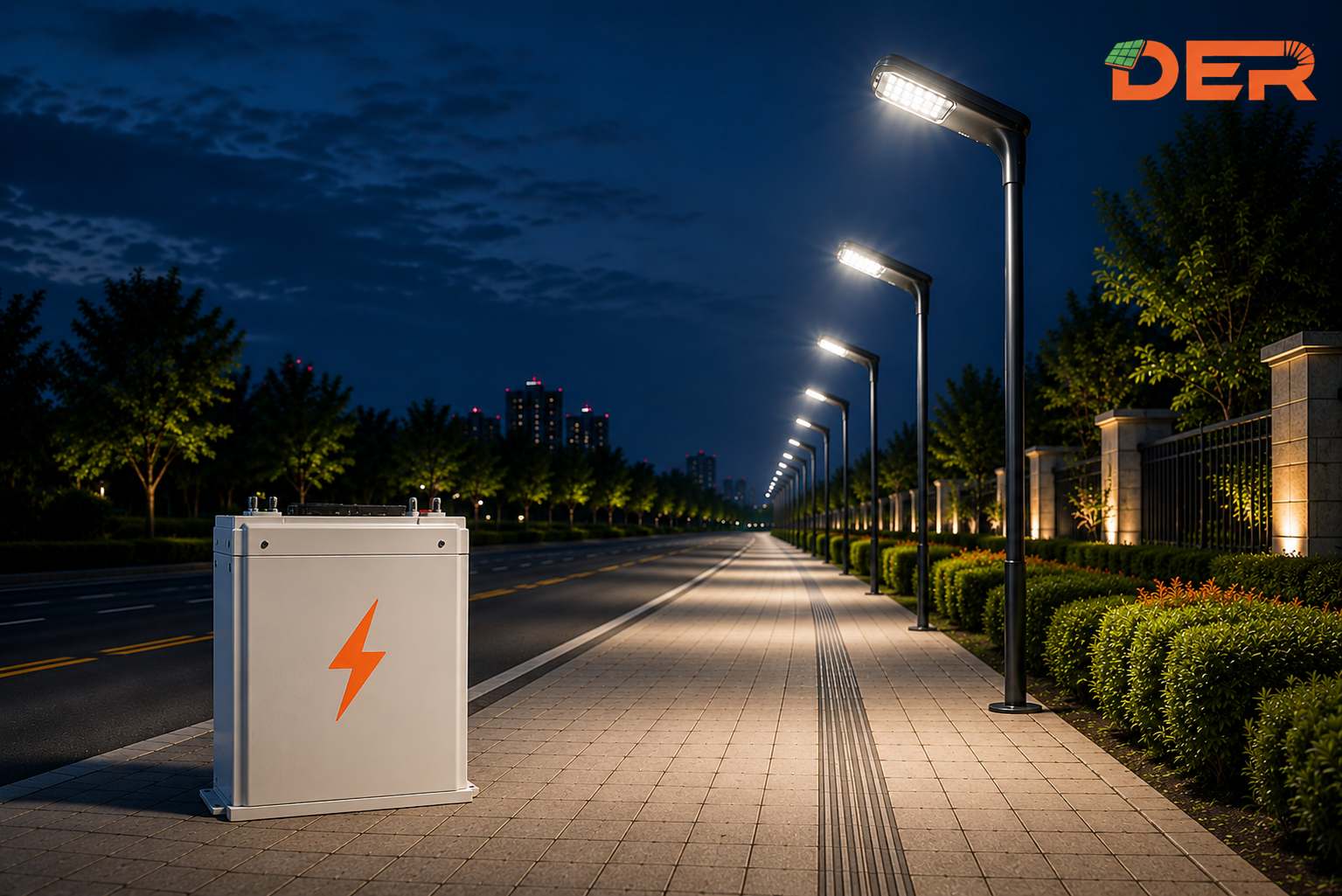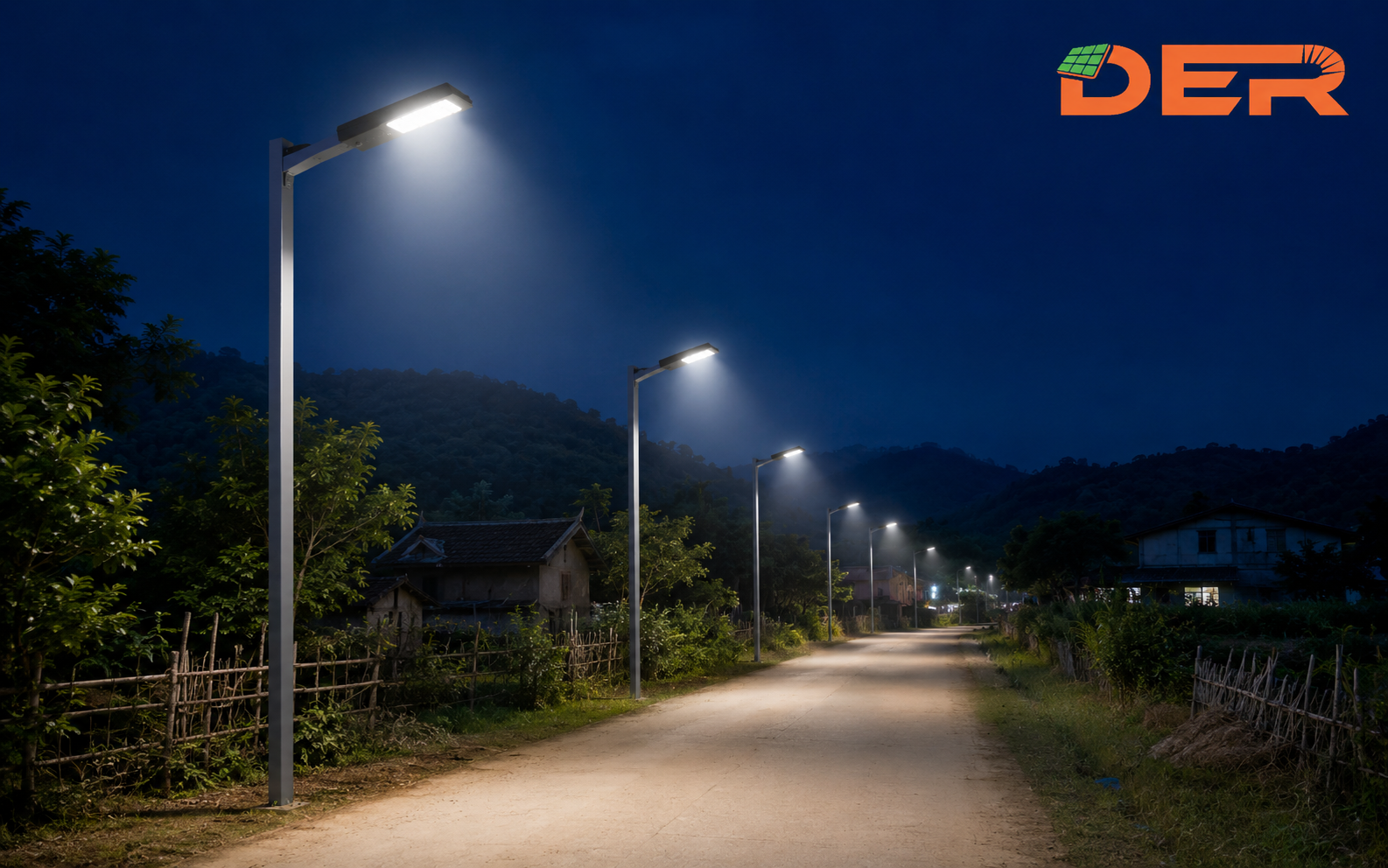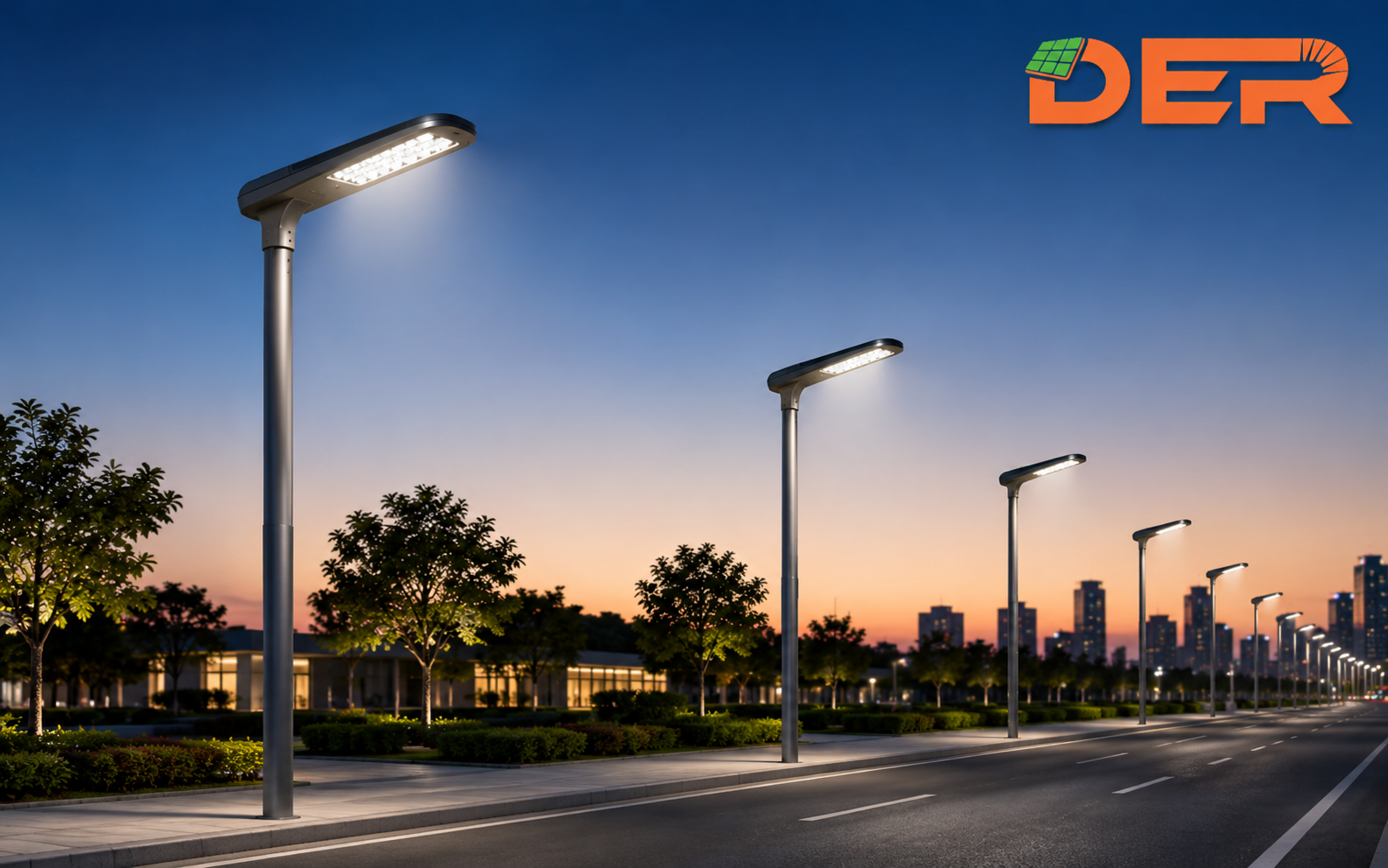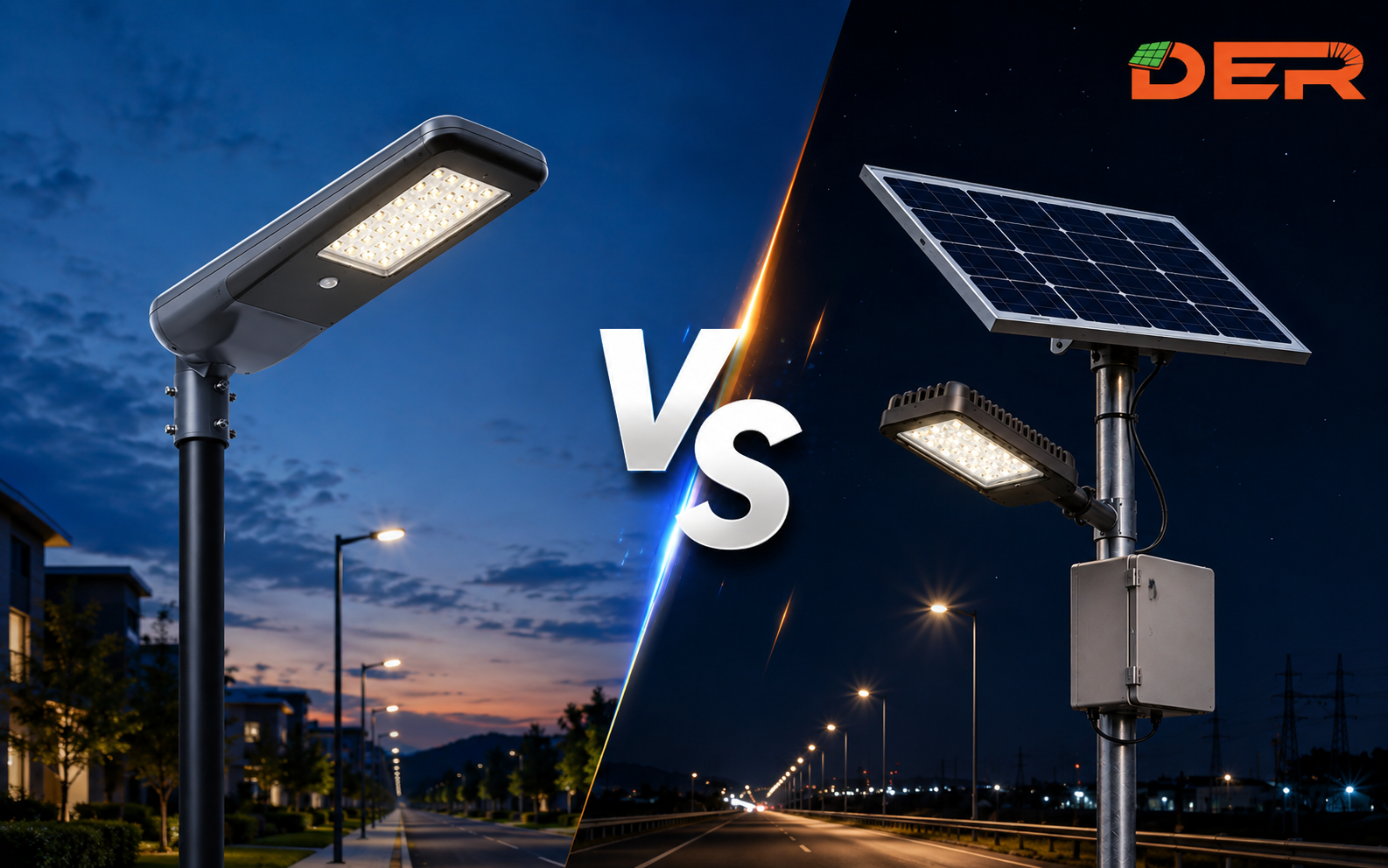
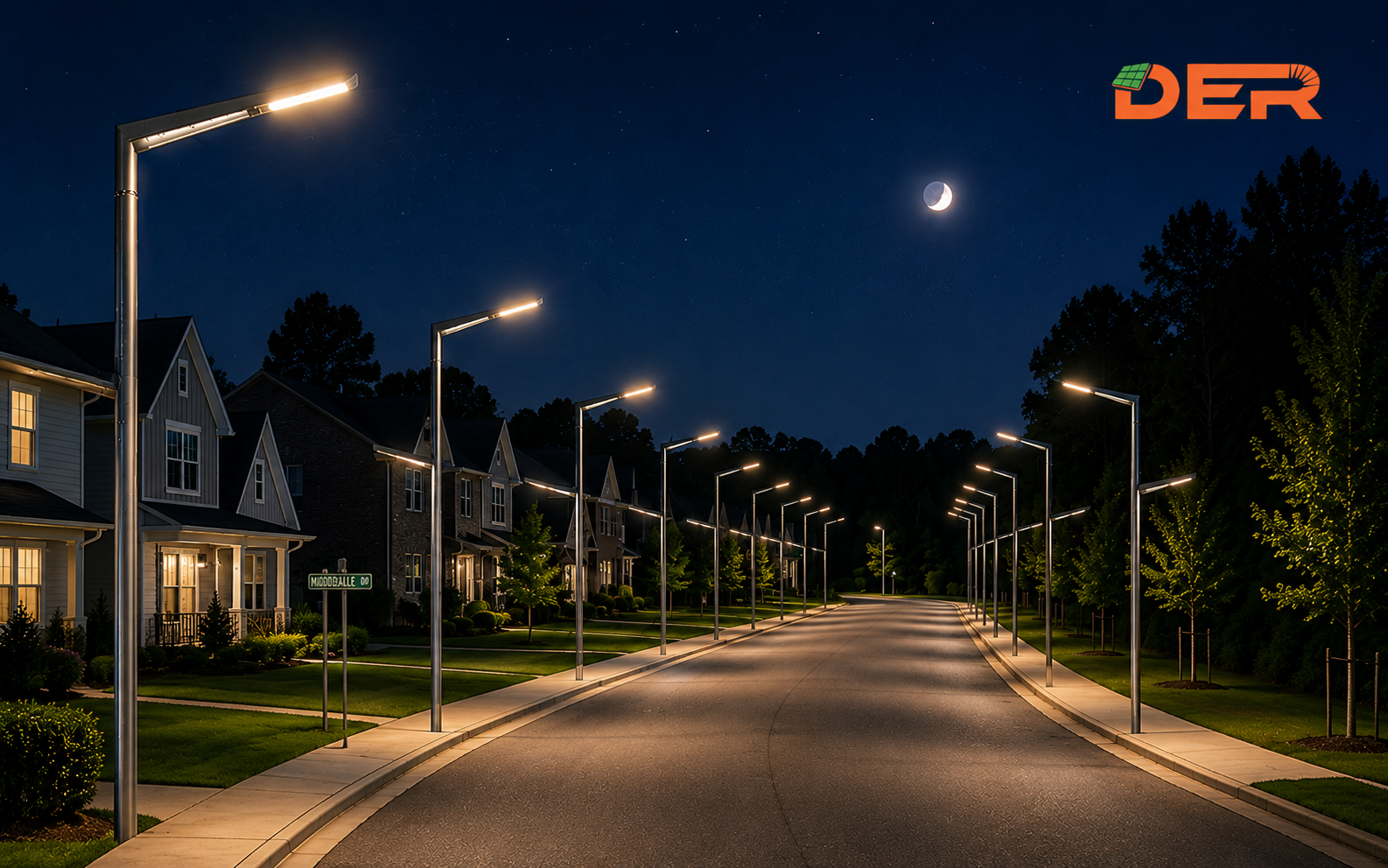
An all in one solar street light is an integrated outdoor lighting system that combines the solar panel, LED light module, lithium battery, charge controller, and motion sensor into a single compact unit mounted on a pole.
It captures sunlight during the day, stores the energy in a built-in battery, and automatically powers the LED light at night.
Since every component is housed together, installation requires no trenching or external wiring, which makes it a popular choice for roads, parking lots, and residential streets.
Key Takeaways
- An all-in-one solar street light integrates the solar panel, battery, controller, LED module, and sensors into one unit.
- Lithium batteries provide longer service life and better charging efficiency than lead-acid alternatives.
- MPPT controllers improve power management and protect battery health.
- Installation is faster because no trenching or external wiring is required.
- Split solar street lights remain a better fit for high-power or large-scale lighting projects.
What Is an All in One Solar Street Light?
An all in one solar street light, sometimes called an integrated solar street light or all in one solar LED street light, is a self-contained lighting system. It eliminates the need for separate solar panels, external batteries, and underground cabling.
All core components are built into one compact housing. These include photovoltaic cells, a rechargeable lithium battery, a controller, and the LED module.
This design differs from traditional street lights, which rely on grid-powered lighting and require continuous underground wiring.
It also differs from split solar street lights, where the solar panel and battery are mounted separately from the light head.
For buyers researching an all in one integrated solar street light, the main appeal is simplicity: one unit, one mounting point, and no dependency on the electrical grid.
How Does an All in One Solar Street Light Work?
An all-in-one solar street light works through a continuous daily cycle of energy conversion, storage, and automatic illumination.
During the day, the solar panel converts sunlight into electrical energy, which is stored in the battery.
At night, a light sensor triggers automatic switching, and the LED light turns on using the stored energy.
Solar Panel Captures Sunlight
The solar panel, typically built from monocrystalline photovoltaic cells, captures sunlight and converts it into direct current (DC) electricity.
Monocrystalline panels generally achieve higher photovoltaic conversion efficiency than polycrystalline alternatives. This helps improve charging performance in regions with fewer sunlight hours.
A Battery Stores Solar Energy
Once electrical energy is generated, it needs somewhere to go. The lithium battery stores this energy for use after sunset.
Lithium iron phosphate (LiFePO4) batteries are commonly used in all in one solar street lights. They offer a longer battery lifespan, better thermal stability, and more consistent charging efficiency than older lead-acid batteries.
Smart Controller Manages Charging and Power
The charge controller, often an MPPT (Maximum Power Point Tracking) or PWM type, regulates how energy moves between the solar panel, battery, and LED light.
MPPT controllers continuously adjust the panel’s operating point to maximize energy conversion. This improves power management and helps protect the battery from overcharging and deep discharge.
Automatic Dusk-to-Dawn Operation
A light sensor detects falling ambient light levels and triggers automatic operation, turning the LED light on at dusk and off at dawn without any manual input.
This dusk-to-dawn operation is one of the defining features that separate all in one solar street lights from conventional lighting that depends on manual switches or timers.
Motion Sensor and Lighting Modes
Many all in one solar LED street lights include a motion sensor that detects nearby movement. It increases brightness when a vehicle or pedestrian approaches and dims during periods of inactivity.
This extends battery life while maintaining safety and light distribution where it is needed most.
Main Components of an All in One Solar Street Light
Understanding the core components helps buyers evaluate quality and compare products from different manufacturers.
- Solar panel: Converts sunlight into electrical energy using photovoltaic cells.
- LED light module: Provides illumination, commonly rated between 160 and 220 lumens per watt depending on the chip quality.
- Lithium battery: Stores solar energy for nighttime illumination and determines runtime and autonomy.
- Smart MPPT controller: Manages charging efficiency and protects the battery from damage.
- Motion sensor: Adjusts brightness based on detected movement to conserve energy.
- Housing and heat dissipation: Aluminum alloy housing protects internal components and dissipates heat to extend LED lifespan.
- Mounting bracket: Secures the unit to a pole and allows the solar panel angle to be adjusted for optimal sunlight capture.
Key Features and Benefits of All in One Sola Street Lights
Integrated All in One Design
Every component is housed in a single compact and lightweight unit, which simplifies transport, installation, and long-term maintenance.
Easy Installation, No Trenching or Wiring Required
Because there is no external cabling between the panel, battery, and light, installation is limited to mounting the pole and securing the fixture. This significantly reduces labor costs and installation time compared to grid-powered lighting.
Energy-Efficient LED Lighting
LED modules used in all in one street light poles consume less power while delivering higher lumen output than traditional sodium vapor or halogen fixtures.
Intelligent Lighting Control
Motion sensors and light sensors work together to manage brightness automatically, improving energy efficiency without sacrificing visibility.
Weather-Resistant Construction
Most all in one solar street light manufacturers build units with an IP65 or IP66 rating. IP66 means the fixture is dust-tight and protected against powerful water jets, which is essential for outdoor durability across seasons.
Long Battery Life and Low Maintenance
Lithium batteries typically last longer than lead-acid batteries because they tolerate deeper discharge cycles and provide higher charging efficiency. This reduces the need for battery replacement and lowers long-term maintenance costs.
Cost Savings and Environmental Benefits
Because the system runs on renewable energy, it eliminates ongoing electricity costs and reduces carbon emissions.
For importers and distributors, these long-term savings on operating costs are often a key argument when presenting solar lighting to municipal or commercial buyers.
Reduced Light Pollution and Reliable Off-Grid Operation
Motion-activated dimming reduces unnecessary light pollution in residential areas, while the self-contained design allows dependable off-grid operation in remote or rural locations without grid access.
Applications of All in One Solar Street Lights
All in one solar street lights are used across a wide range of settings, including:
- Roads and highways, both rural and urban
- Residential communities and neighborhood streets
- Parking lots and commercial areas
- Parks, pathways, and sidewalks
- Industrial and commercial facilities
- Remote and off-grid locations without access to grid power
Their flexibility makes them suitable wherever installing conventional grid-powered lighting would be costly or impractical. DER Lighting offers dedicated product series for different applications.
All in One vs Split Solar Street Lights
| Feature | All-in-One | Split |
| Design | Fully integrated in one unit | Panel and battery mounted separately |
| Installation | Fast, no wiring | More complex, requires cabling |
| Maintenance | Lower, fewer parts to service | Higher, more components to inspect |
| Performance | Suitable for standard lighting needs | Better for high-power, high-mast applications |
| Flexibility | Limited to compact battery capacity | Larger battery and panel options available |
| Cost | Lower upfront and installation cost | Higher upfront cost, more customizable |
Split solar street lights generally suit large-scale or high-power projects where battery capacity needs exceed what a compact all in one solar led street light unit can accommodate.
All in one units, on the other hand, are typically preferred for standard road and pathway lighting where speed of deployment matters.
How to Install an All in One Solar Street Light
Tools and Materials Required
Installing an all in one solar street light typically requires the following:
- Mounting pole or existing structure suitable for the unit’s weight
- Anchor bolts or a foundation cage (for direct-burial or concrete-base poles)
- Wrench or socket set for tightening bracket bolts
- Screwdriver for securing panel angle adjustments and access panels
- Concrete mix (if a new foundation is being poured)
- Level, to ensure the pole and panel are mounted straight
- Ladder or lifting equipment, depending on pole height
- Basic protective gear (gloves, safety glasses)
Steps to Follow:
- Step 1: Select the installation location. Choose a spot with direct, unobstructed sunlight exposure for most of the day.
- Step 2: Install the pole or bracket. Secure the all in one solar street light pole into the ground or an existing mounting surface using anchor bolts.
- Step 3: Mount the light. Attach the integrated unit to the top of the pole and confirm all connections are tight.
- Step 4: Adjust the solar panel angle. Position the panel to face the direction of maximum sunlight exposure based on regional latitude.
- Step 5: Test the system. Cover the light sensor briefly to confirm the LED light activates, then confirm the motion sensor responds correctly.
How to Choose the Right All in One Solar Street Light
Selecting the right all in one integrated solar street light depends on matching product specifications to project requirements.
- Lighting requirements: Match lumen output to the width and purpose of the area being lit.
- Solar panel efficiency: Higher-efficiency panels charge faster and perform better in low-sunlight regions.
- Battery capacity: Larger battery capacity supports more autonomy during consecutive cloudy days.
- LED brightness: Confirm lumen output aligns with local lighting standards for roads or public spaces.
- Pole height: Taller poles suit highways, while shorter poles suit pathways and residential streets.
- Weather conditions: Consider wind load, temperature extremes, and rainfall when selecting housing materials.
- IP rating: Look for IP65 or higher for reliable weather resistance.
- Warranty: Longer warranties often indicate confidence in battery lifespan and build quality.
- Manufacturer support: Reliable technical support and spare part availability matter for long-term projects. Explore DER Lighting’s services to understand how the right manufacturing partner can support your project beyond product supply.
Looking for the Right All-in-One Solar Street Light?
Understanding how an all-in-one solar street light works is the first step toward selecting the right solution for your project. However, choosing the right model depends on factors such as installation environment, lighting requirements, battery capacity, and pole height.
At DER Lighting, we specialize exclusively in all-in-one solar street lights for distributors, importers, wholesalers, and project buyers.
Our product range includes solutions for residential streets, highways, commercial areas, industrial sites, and large-scale infrastructure projects.
Whether you’re exploring our product series, comparing specifications, or considering OEM/ODM manufacturing support, our team can help you find the right all in one solar street light for your project. Browse our product range, learn more about our services, or contact us to request a product catalog or quotation.
Conclusion
An all in one solar street light is a self-contained, solar-powered lighting system that combines the solar panel, lithium battery, smart controller, LED module, and motion sensor into a single housing. It converts sunlight into stored energy during the day and provides automatic illumination at night.
It suits roads, residential areas, parking lots, and remote locations where grid-powered lighting is costly or impractical. When choosing a manufacturer, buyers should weigh battery capacity, solar panel efficiency, IP rating, and warranty support to ensure long-term reliability and savings.
Frequently Asked Questions (FAQs):
An all in one solar street light is an outdoor lighting unit with the solar panel, battery, LED light, and controller built into a single fixture. This removes the need for separate wiring or external components.
Yes, they’re a reliable option for most outdoor lighting needs, especially with decent sunlight exposure. They lower electricity costs while still providing consistent nighttime illumination.
A well-built solar street light typically lasts 8 to 10 years, with the battery usually needing replacement after 5 to 8 years. Lifespan depends on build quality, climate, and maintenance.
Yes, the battery stores surplus energy from sunny periods to keep the light running. It can continue operating for several consecutive cloudy days depending on battery capacity.
No, there’s no external wiring or trenching required. Installation usually just involves mounting the pole and securing the unit.