Choosing the right all in one solar street light supplier involves more than comparing prices. Buyers should evaluate manufacturing capabilities, product quality, certifications, testing procedures, customization options, warranty terms, technical support, and supply reliability before placing an order.
Asking the right questions helps reduce project risks and improves long-term performance for any all in one solar street light project, whether it’s a single pilot installation or a bulk municipal order.
A Quick Supplier Evaluation Checklist
| Evaluation Area | Question to Ask | Why It Matters |
|---|---|---|
| Factory | Do you manufacture in-house? | Quality control |
| Certifications | Which standards do you comply with? | Compliance |
| Components | Which brands are used? | Reliability |
| Testing | What tests are performed? | Consistency |
| Warranty | What is covered? | Lower risk |
| Support | How are issues handled? | Faster resolution |
| OEM | Can products be customized? | Branding |
| Production | What is your lead time? | Supply planning |
Why Is Choosing the Right Supplier Just as Important as Choosing the Right Product?
The performance of an all in one led solar street light depends heavily on who builds it, not just what it’s made of.
Two products can list nearly identical specifications on paper and still perform very differently in the field. This happens because product quality is only as reliable as the supplier’s manufacturing process, quality control, and component sourcing behind it.
Long-term support matters just as much as the initial purchase. A supplier that manufactures its own products can usually provide spare parts, technical documentation, and consistent quality across every batch.
This consistency becomes critical for projects involving hundreds or thousands of units, where a small defect rate can turn into a large maintenance burden. Ultimately, project success depends on partnering with a supplier who can support the product for its full service life, not just at the point of sale.
10 Key Questions to Ask Before Choosing an All in One Solar Street Light Supplier
Below are the 10 core questions that importers, distributors, and procurement managers should ask before signing a purchase order. Each question targets a specific risk area, from manufacturing transparency to after-sales support.
- Does the Supplier Manufacture the Products or Only Trade Them?
This is the first question to ask, and it shapes every answer that follows. A factory-direct supplier controls its own production line, quality control, and component sourcing. A trading company, on the other hand, resells products made by a third party and often has limited visibility into how those products were built.
Ask whether the company owns its manufacturing facility or works with subcontracted factories.
A real professional manufacturer of all in one solar street lights can usually arrange a factory audit or provide production line footage. A trading company may avoid this request or delay it indefinitely, which is itself a useful signal.
- What Certifications Do the Products and Factory Have?
Certifications are one of the clearest ways to verify quality without visiting the factory in person. Look for ISO 9001, which demonstrates a functioning quality management system, and ISO 14001, which covers environmental management practices.
CE marking confirms compliance with European safety and electromagnetic compatibility requirements, while RoHS certification confirms the product is free from specific hazardous materials.
IEC standards, particularly IEC 60529, define IP ratings such as IP65 and IP66, which describe how well the housing resists dust and water.
For lighting design purposes, ask whether the supplier can provide IES files, since these photometric reports are essential for simulating light distribution on a road or pathway before installation.
- What Components Are Used Inside the Street Light?
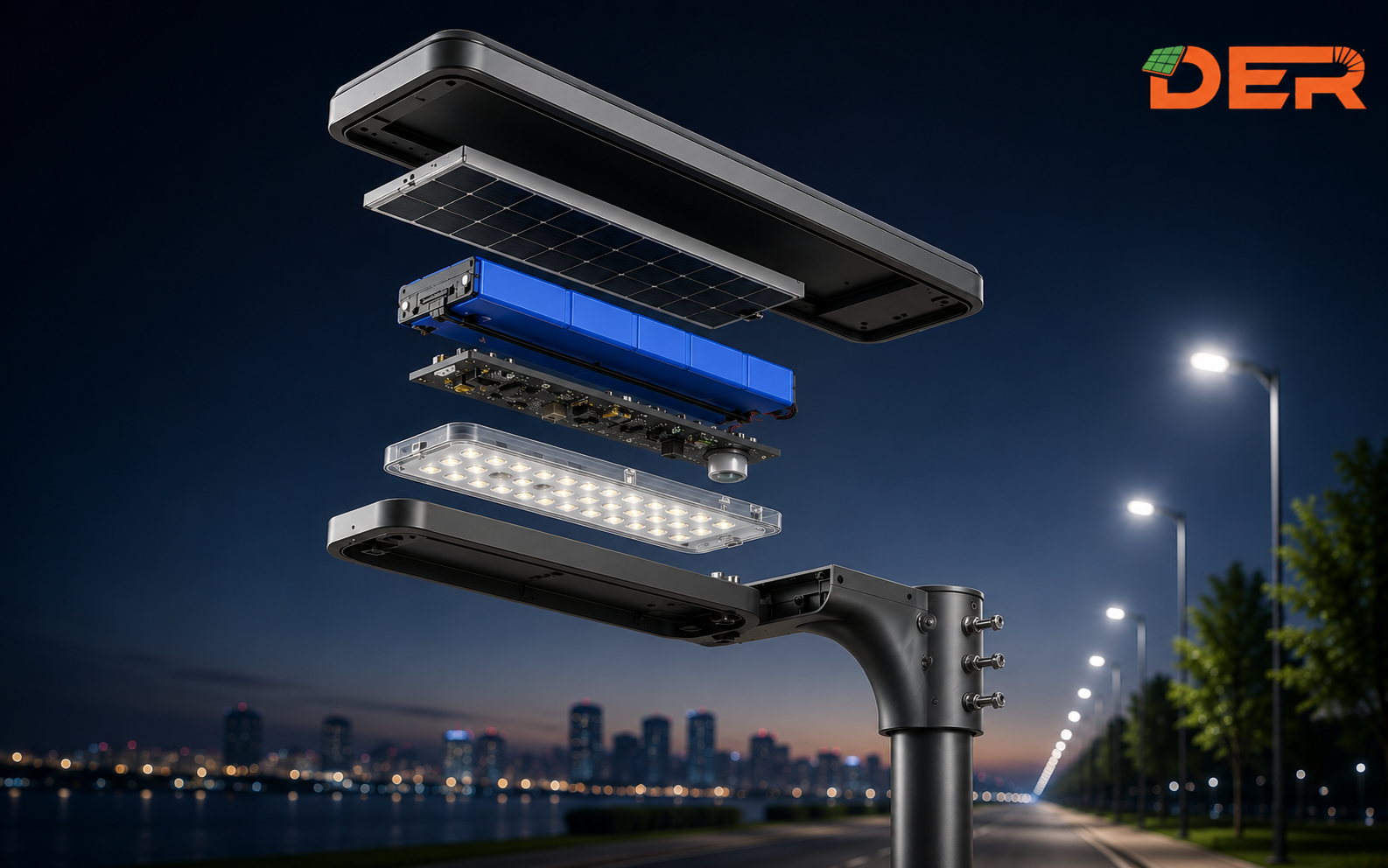
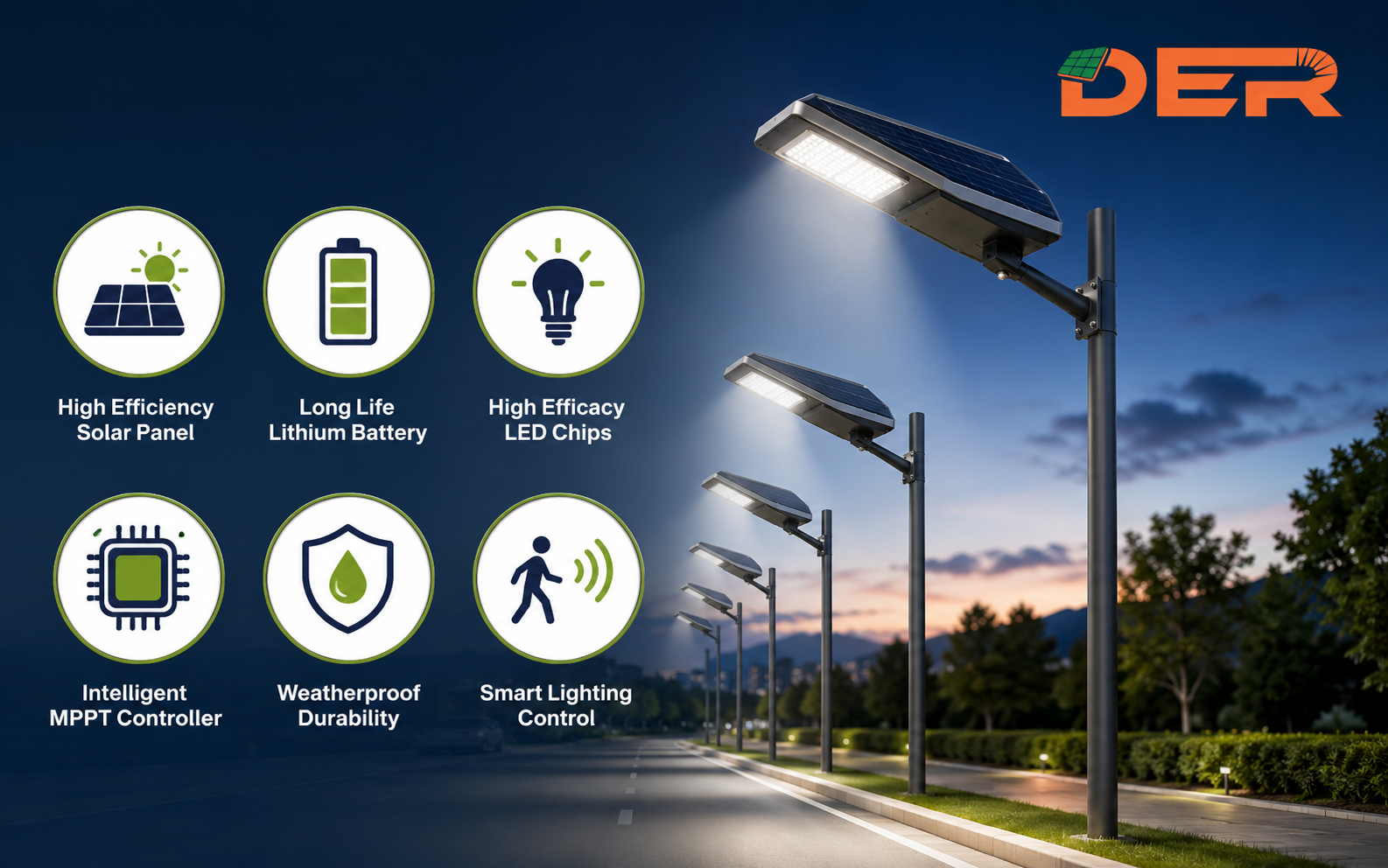
An all in one integrated solar street light is only as good as its weakest component. Ask specifically about the LED brand and chip type, since LED efficacy varies significantly between manufacturers.
Ask about the battery brand and chemistry, since LiFePO4 batteries generally outperform standard lithium-ion or lead-acid alternatives in cycle life and thermal stability.
Also confirm the solar panel type, whether monocrystalline or polycrystalline, and the controller brand, since MPPT controllers charge more efficiently than older PWM designs. Finally, ask about the housing material.
Aluminum housing with proper heat dissipation design protects the internal components and extends the working life of the entire unit.
- How Is Product Quality Tested Before Shipment?
A reliable all in one solar street light manufacturer should have documented testing procedures rather than relying on visual inspection alone. Ask about aging tests, which run the light for an extended period before shipment to catch early failures. Ask about waterproof testing, which verifies the IP rating under real conditions rather than just on a datasheet.
Battery tests and photometric testing are also worth asking about, since these confirm that the unit performs as specified once it reaches the field. A supplier should also describe its inspection procedures, including incoming material inspection and final inspection before packing.
- Can the Supplier Provide Photometric Reports and Technical Documentation?
Documentation is often the fastest way to separate a serious manufacturer from a reseller. Ask for IES files, detailed datasheets, installation manuals, and any relevant test reports.
These documents help your engineering team confirm that the all in one solar led street light will meet the required lux levels and uniformity standards for your specific project before any units are ordered.
- Can the Supplier Customize Products for Your Business?
Many B2B buyers need more than a standard catalog item. Ask whether the supplier offers OEM or ODM services, meaning the product can be built or modified specifically for your brand.
This can include private label packaging, custom branding, firmware adjustments, specific wattage configurations, and different optics for different road widths.
Customization capability is also a sign of manufacturing maturity. A supplier that can adjust an all in one solar street light pole height, mounting bracket, or dimming profile on request usually has more in-house engineering support than one offering only fixed configurations.
- What Warranty Is Offered, and What Does It Actually Cover?
Warranty length is easy to compare, but warranty scope is what actually matters. Ask specifically what is covered for the battery, LED module, and controller, since these components often carry different warranty periods.
Ask about exclusions as well. Most warranties do not cover vandalism, theft, or damage from improper installation.
It also helps to understand the replacement process in advance. Ask how long it typically takes to receive a replacement part and whether the supplier covers shipping costs for warranty claims.
- How Does the Supplier Handle Technical Support and After-Sales Service?
Ask how the supplier handles troubleshooting when an issue arises after installation. A responsive supplier should be able to walk your team through basic diagnostics remotely and ship spare parts quickly when needed. Ask about typical response times for support requests, since slow communication after the sale is one of the most common complaints among B2B buyers.
Installation guidance is another area worth confirming, especially for larger orders. Some suppliers provide video guides or on-site support for the first batch of a new project.
- Can the Supplier Handle Your Required Order Volume and Delivery Schedule?
Before finalizing a supplier, confirm their minimum order quantity, current production capacity, and typical lead time.
This matters more for larger bulk orders, where a mismatch between promised and actual capacity can delay an entire project. Ask about inventory levels for standard models and shipping logistics for your destination country, since this affects both cost and delivery schedule planning.
- Can the Supplier Provide References or Previous Project Experience?
Project references are one of the most reliable ways to verify a supplier’s real-world performance. Ask for case studies, especially from projects in a climate or application similar to yours.
Export experience to your target region is also worth confirming, since a supplier familiar with your local certification requirements and climate conditions can often anticipate issues before they happen.
Photos from completed installations and direct customer references add another layer of verification beyond marketing materials alone.
What Are the Warning Signs of an Unreliable Supplier?
A few red flags tend to appear consistently among unreliable suppliers:
- Unusually low prices with no clear explanation for the cost difference
- Incomplete or vague product specifications
- Refusing a factory audit or avoiding questions about production location
- Vague or overly broad warranty language
- Inconsistent or slow communication during the quotation stage
- No certifications, or certifications that cannot be verified
- Unrealistic performance claims, such as extreme lumen output paired with a small battery
- Product images that appear copied from other manufacturers’ websites
Any one of these signs on its own may not be disqualifying, but several appearing together is a strong reason to keep evaluating other suppliers.
Ask the Questions. DER Lighting Has the Answers.
Choosing the right supplier starts with asking the right questions, and a reliable manufacturer should be able to answer them with confidence. At DER Lighting, we believe transparency is the foundation of every successful partnership. We provide clear product specifications, verified certifications, documented quality testing, OEM and ODM customization, and responsive after-sales support to help you make informed purchasing decisions.
Whether you’re an importer, distributor, wholesaler, or OEM buyer, our team is ready to help you find the right all in one solar street light solution for your project. Contact DER Lighting today to discuss your requirements, request technical documentation, or speak with our experts before placing your next order.
Conclusion
Choosing an all in one solar street light supplier comes down to trust built on evidence, not price alone. Verified certifications, tested components, clear warranty terms, and responsive after-sales support all point to a manufacturer capable of supporting a project long after the sale.
Buyers who ask these 10 questions upfront avoid costly surprises later. The right supplier partnership protects both your investment and your project’s long-term lighting performance.
Frequently Asked Questions
Ask for factory audit access, production line photos or video, and details about in-house quality control. A real manufacturer will typically share this information readily, while a trading company may avoid or delay these requests.
A good solar street light uses a LiFePO4 battery, a monocrystalline panel, an MPPT controller, and at least an IP65 waterproof rating. It should also come with clear test reports and a warranty of 3 years or more.
Look for ISO 9001 for quality management, CE for safety compliance, RoHS for hazardous material restrictions, and an appropriate IP rating such as IP65 or IP66 for weather resistance. IES files are also valuable for lighting design verification.
It depends on your project. OEM and ODM capabilities matter most for buyers who need private branding, specific wattage configurations, or optics tailored to a particular road layout. For standard catalog orders, it may be less of a priority.
Most reputable manufacturers offer 3 to 5 years on standard components, with some premium systems extending to 5 to 10 years. Always confirm what is included, since battery, LED, and controller coverage often differ.
At minimum, request a detailed datasheet, an installation manual, and any available test reports. For larger projects, also request IES files and photometric simulations to confirm the light will meet your project’s illumination requirements.
No. The lowest price often reflects reduced component quality, thinner testing procedures, or limited after-sales support. A better approach is comparing total cost of ownership, including maintenance and replacement costs, rather than the upfront quote alone.