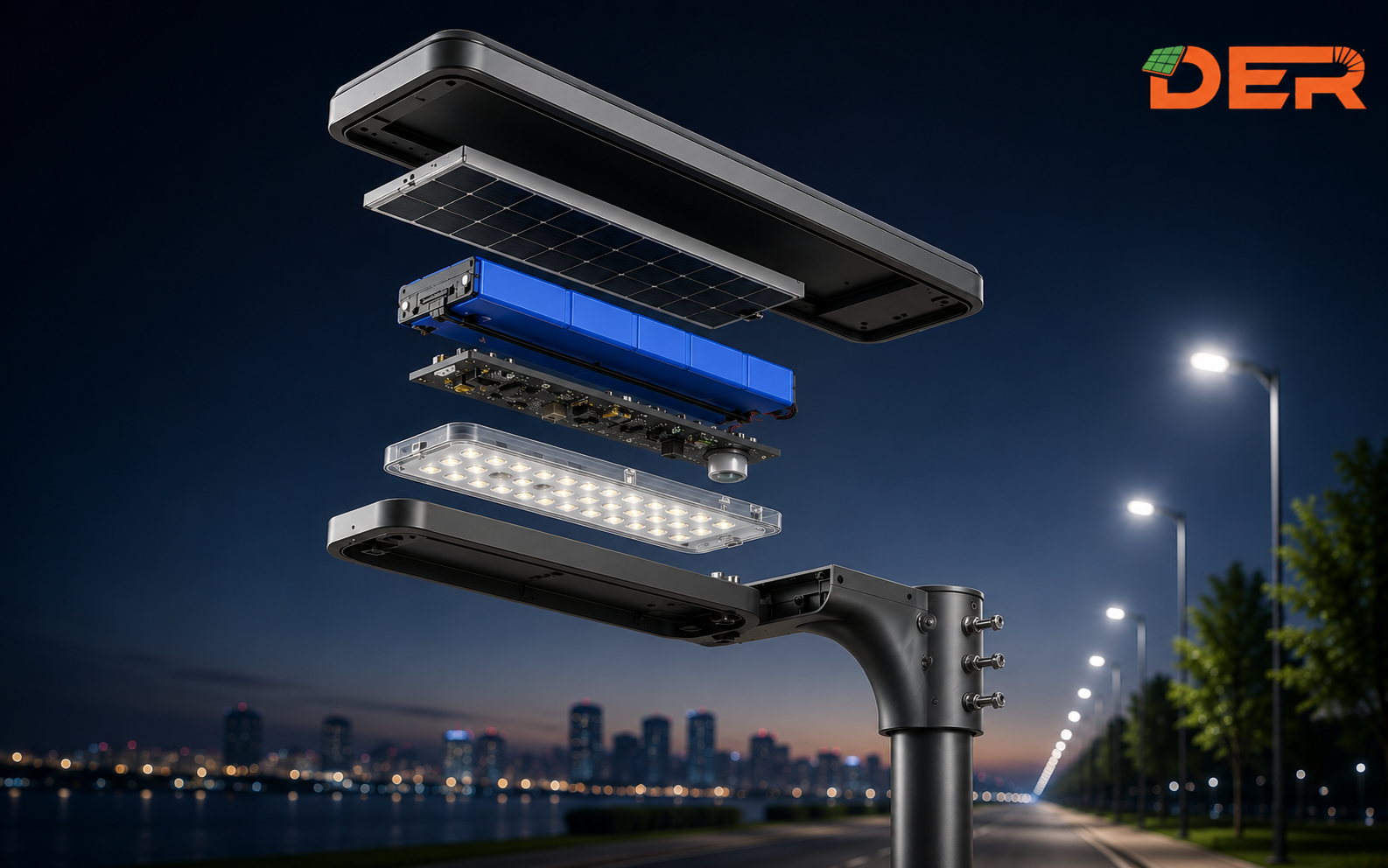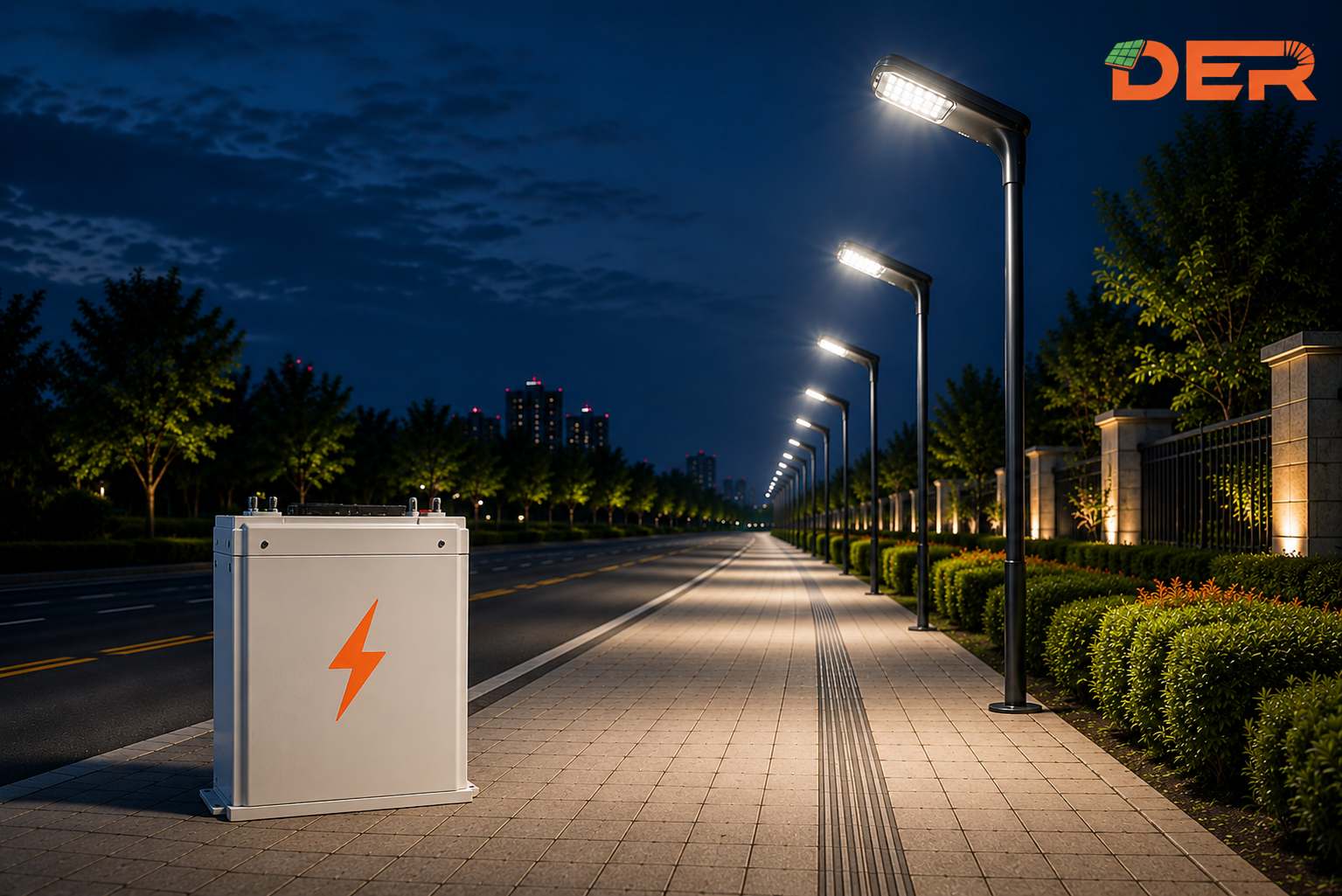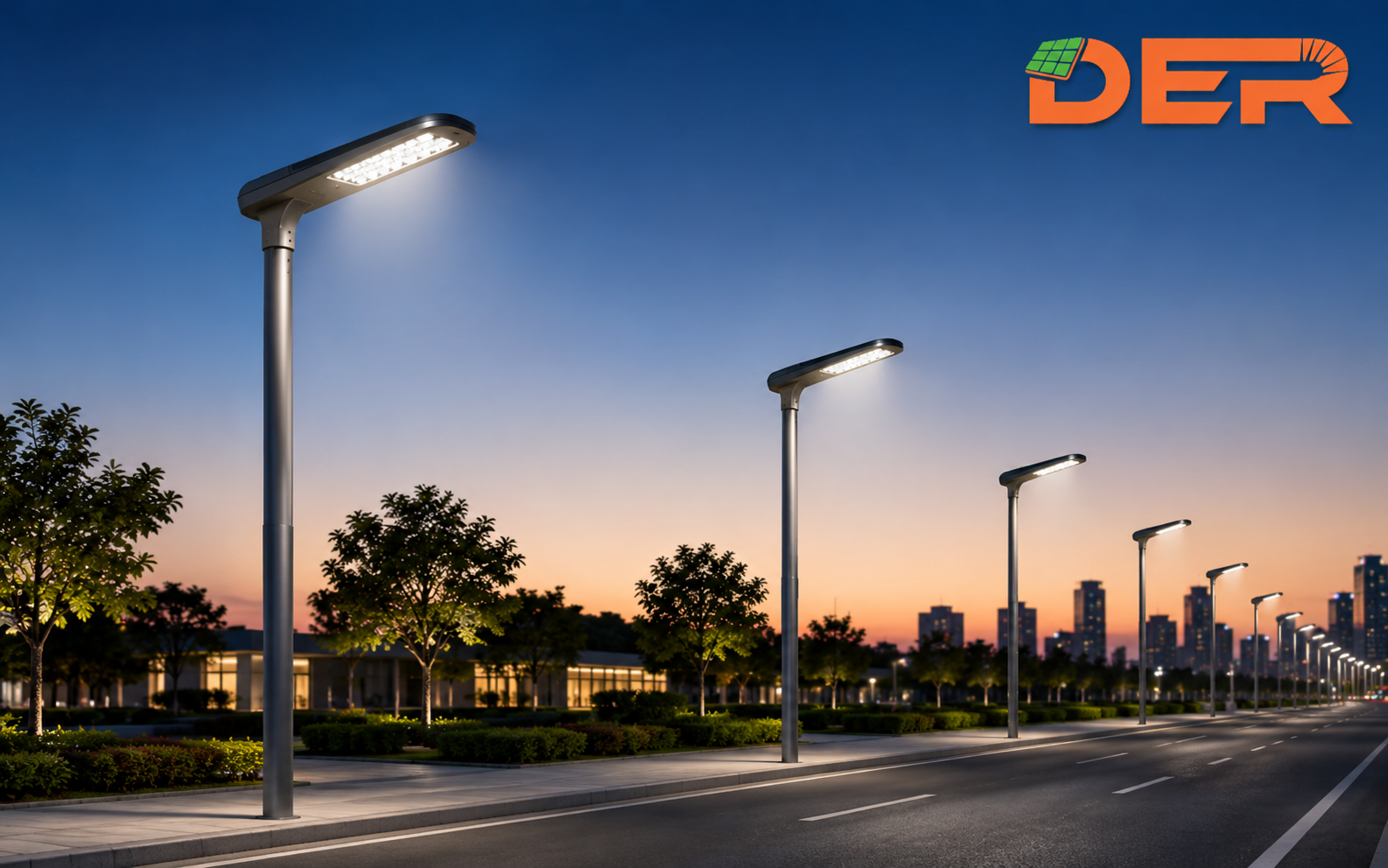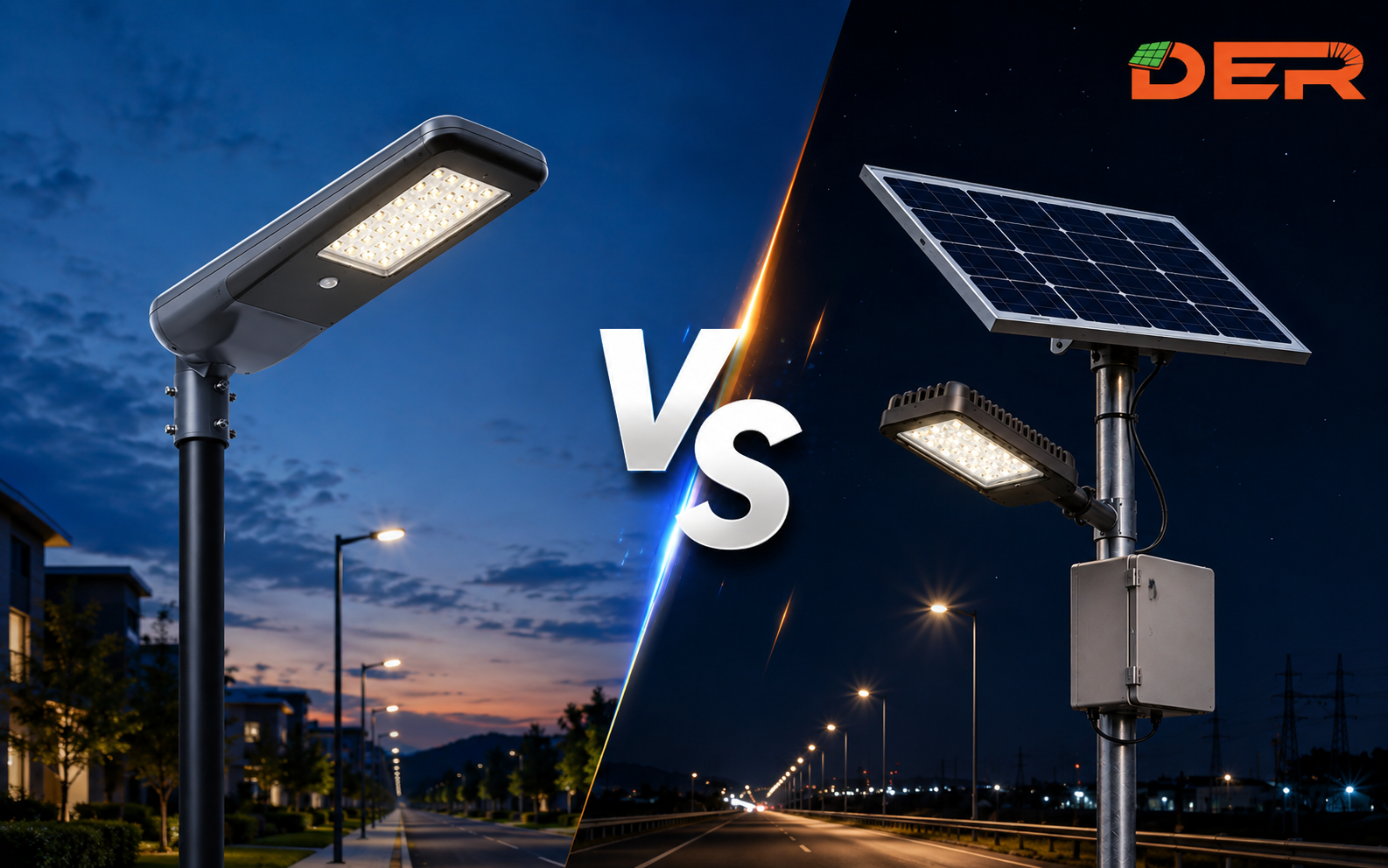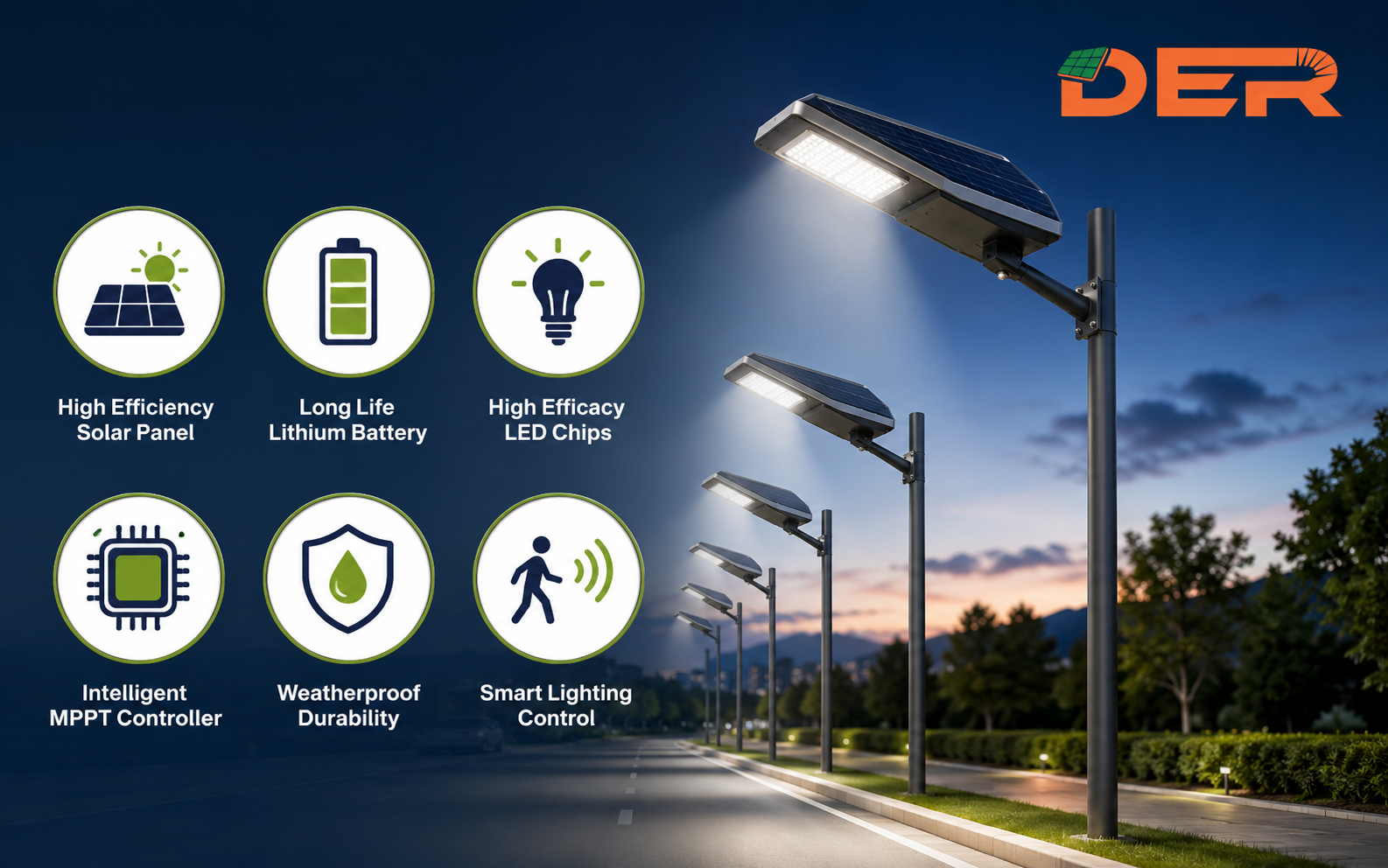
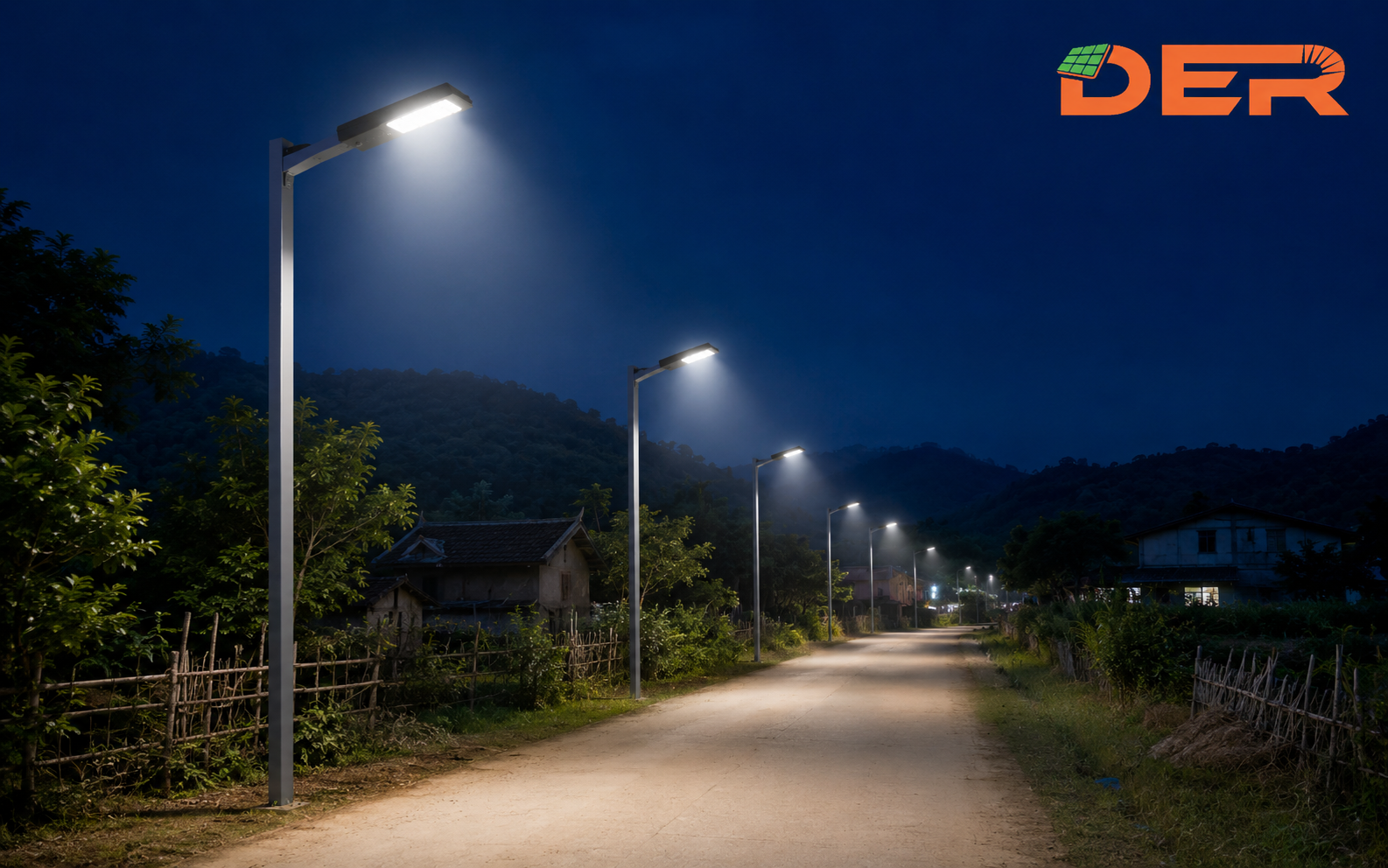
An all in one solar street light is well-suited for rural roads and community projects because it combines the solar panel, battery, LED module, and controller into a single unit.
This design removes the need for trenching or external wiring, which makes installation faster in remote locations.
They work best for moderate lighting needs such as village roads, residential streets, parking lots, parks, and school access roads.
Before buying, project owners should evaluate road conditions, local climate, pole height, and battery capacity to match the light to the actual site requirements.
Key Takeaways
- All in one solar street lights integrate the solar panel, battery, LED module, and controller into a single housing.
- They are well suited to rural roads and community projects due to easy installation and low maintenance needs.
- LiFePO₄ batteries offer longer service life and better heat tolerance than older battery chemistries.
- MPPT controllers improve charging efficiency compared to standard PWM controllers.
- Local climate and site conditions should be evaluated before choosing battery capacity and pole specifications.
- Lifecycle cost, not just upfront price, should guide the final purchasing decision.
Why Are All in One Solar Street Lights Ideal for Rural Roads and Community Projects?
An all in one solar street light is a strong fit for rural and community settings because it delivers dependable lighting without relying on grid infrastructure. It also keeps installation and maintenance simple, which matters in areas with limited technical support.
Moderate lighting needs
Rural roads and community paths typically require steady, functional illumination rather than the high-output lighting used on highways. An all in one integrated solar street light is designed around this moderate lighting profile, so it avoids the cost of oversized components.
Off-grid locations
Many rural roads sit far from the power grid. Because the solar panel, battery, and LED light source are self-contained, the light generates and stores its own energy and does not depend on a grid extension.
Quick installation
Since there is no external wiring or trenching involved, an all in one solar street light pole can usually be installed with a single foundation and a mounting step. This plug-and-play installation approach shortens deployment time significantly compared to grid-powered alternatives.
Low maintenance
With fewer external cables and connection points, there is less that can fail in the field. This is especially valuable in areas where maintenance access is limited or technical crews are not readily available.
Lower lifecycle cost
Even though the upfront cost of an integrated solar street light may be similar to other options, the reduced installation labor and lower long-term maintenance costs typically bring down the total cost of ownership.
Common applications
All in one solar LED street lights are commonly used for village roads, residential streets, pedestrian walkways, parking lots, public parks, and campuses. These are all settings where moderate output and simple deployment matter more than maximum lumen output.
What Project Conditions Should You Evaluate Before Choosing an All in One Solar Street Light?
Before selecting a specific model, buyers should assess the physical and usage conditions of the project site. These factors determine pole height, spacing, and the lighting profile the site actually needs.
Road type
Road type affects the required light distribution and mounting height. A narrow village road has different needs from a two-lane residential street.
Road width
Wider roads generally require either taller poles or a wider beam angle to achieve even light distribution across the full road surface.
Pole height
Pole height influences both the coverage area and the uniformity ratio of the light on the ground. Most rural and community roads use pole heights between 6 and 9 meters, depending on road width.
Pole spacing
Pole spacing works together with pole height to determine how continuous the lighting coverage will be. Wider spacing reduces the number of poles needed but can create dark gaps between light circles if not calculated correctly.
Traffic volume
Roads with higher traffic volume typically need brighter, more uniform lighting for safety. Lower traffic roads can often use dimming or motion-activated lighting modes to save energy.
Pedestrian activity
Areas with regular pedestrian traffic, such as school routes or community parks, benefit from more even light distribution and lower glare, since people are walking rather than driving.
Maintenance accessibility
Remote sites with limited maintenance access benefit from all in one solar street light components with longer service life and stronger battery protection, since repairs may not happen quickly.
| Project Factor | Why It Matters | What Buyers Should Check |
| Road type | Determines beam pattern and mounting needs | Village, residential, or access road classification |
| Road width | Affects pole height and spacing | Measured road width in meters |
| Pole height | Impacts coverage area and uniformity | Height suited to road width |
| Pole spacing | Affects continuity of lighting coverage | Distance between planned poles |
| Traffic volume | Determines the required brightness level | Vehicle traffic estimates |
| Pedestrian activity | Affects glare control and distribution | Foot traffic patterns |
| Maintenance accessibility | Impacts component durability needs | Distance to service teams |
What Technical Specifications Matter Most?
The specifications that matter most for an all in one solar street light are battery type, battery capacity, solar panel efficiency, LED efficacy, charge controller type, weather protection rating, and housing material.
Each of these affects how reliably the light performs over its service life.
Battery type
Lithium iron phosphate, commonly known as LiFePO₄, is the preferred battery chemistry for all in one solar street lights. It tolerates deeper discharge cycles, performs better in high temperatures, and has a longer lifespan than older lithium-ion or lead-acid alternatives.
Battery capacity
Battery capacity determines runtime and autonomy days, which is how many consecutive cloudy days the light can operate without recharging. For rural roads with variable weather, buyers should evaluate battery capacity alongside local sunshine hours rather than choosing based on wattage alone.
Solar panel efficiency
Monocrystalline solar panels are the standard choice for all in one solar street lights due to their higher conversion efficiency. Higher efficiency allows the panel to generate more energy per unit of surface area, which matters in compact all-in-one designs with limited panel space.
LED efficacy
LED efficacy measures how much light output a fixture produces per watt of power consumed. Quality LED chips commonly achieve 160 to 220 lumens per watt, and higher efficacy allows for brighter output without increasing power consumption.
Charge controller
An MPPT controller, short for maximum power point tracking, adjusts the electrical load to capture the maximum available energy from the solar panel. This charging logic improves overall energy harvest compared to older PWM controllers, especially during partly cloudy conditions.
Weather protection
An IP66 rating means the fixture is dust-tight and protected against powerful water jets from any direction. This level of weather resistance is important for outdoor fixtures exposed to rain, dust, and seasonal weather extremes.
Housing material
Die-cast aluminum housing offers strong corrosion resistance and effective heat dissipation. Good thermal management helps protect the LED module and battery from performance loss caused by heat buildup.
| Specification | Recommended | Why It Matters |
| Battery type | LiFePO₄ | Longer lifespan, better heat tolerance |
| Battery capacity | Matched to autonomy needs | Determines runtime during cloudy periods |
| Solar panel | Monocrystalline | Higher conversion efficiency |
| LED efficacy | 160 to 220 lm/W | Higher light output per watt |
| Charge controller | MPPT | Maximizes energy harvest |
| Weather protection | IP66 | Dust-tight, water jet resistant |
| Housing material | Die-cast aluminum | Corrosion resistance, heat dissipation |
How Do Local Climate and Site Conditions Affect Performance?
Local climate directly affects how much energy an all in one solar street light can generate and store. Sites with fewer peak sun hours or frequent cloudy weather need larger battery capacity to maintain the same autonomy.
Rainy seasons, shading, and dust accumulation all reduce daily energy generation, which can shorten runtime on consecutive nights.
High temperatures also affect battery lifespan, which is why LiFePO₄ batteries are preferred in hot climates.
These factors form a simple chain: battery capacity affects runtime, runtime affects autonomy, and autonomy determines how many cloudy days the light can operate without recharging.
For importers and distributors, battery capacity should always be evaluated alongside local solar irradiance data rather than treated as a fixed number across regions.
How Can You Match the Right Light to Your Project?
Matching the right light to a project starts with identifying the primary use case, since different applications call for different beam patterns, output levels, and features.
| Project | Recommended Characteristics | DER Series |
| Village roads | Moderate output | A Series |
| Residential roads | Balanced lighting | A Series |
| Parking lots | Wider beam | A Series |
| Community parks | Motion sensor option | A Series |
| Schools | Reliable overnight lighting | A Series |
Village roads generally call for moderate output levels, since traffic volume and pedestrian activity are lower than in dense residential zones. Residential roads benefit from balanced lighting that avoids harsh glare near homes.
Parking lots typically need a wider beam angle to cover open areas without leaving dark corners.
Community parks often benefit from a motion sensor option, since foot traffic is inconsistent and adaptive lighting can extend battery life during low-activity hours. Schools require reliable overnight lighting along access roads and walkways, particularly for early morning or evening activities.
What Mistakes Should Buyers Avoid?
The most common mistakes happen when buyers focus on a single specification instead of evaluating the full project profile.
- Choosing by wattage only, without considering LED efficacy or actual lumen output
- Ignoring pole spacing, which can create uneven lighting even with the right pole height
- Ignoring local climate, which affects battery sizing and autonomy
- Underestimating battery capacity, leading to reduced runtime during cloudy seasons
- Comparing price instead of lifecycle cost, which overlooks long-term maintenance savings
- Overlooking supplier support, including warranty terms and access to replacement parts
How Should You Evaluate an All-in-One Solar Street Light Supplier?
A reliable manufacturer of all in one solar street lights should offer relevant certifications, a clear warranty, and responsive technical support, since these affect both product quality and after-sales service.
Certifications from bodies like the IEC or ISO confirm the product meets established safety and performance standards. Warranty terms and coverage details are worth reviewing closely, as they vary widely between suppliers.
Buyers should also check whether the supplier offers lighting simulations or photometric reports, customization options, and available spare parts. For larger or branded projects, it is worth confirming production capacity and OEM/ODM support as well.
Need Help Choosing the Right All-in-One Solar Street Light?
Every rural road and community project has unique lighting requirements. Factors such as road width, pole spacing, local climate, and required autonomy all influence the ideal product specification.
If you’re planning a new project or sourcing products for distribution, DER Lighting can help you select an all-in-one solar street light that matches your application and performance requirements. We also provide technical guidance, OEM/ODM customization, and product recommendations based on your project needs.
Contact our team today to discuss your project or request a quotation from our team.
Conclusion
All in one solar street lights are a practical, low-maintenance choice for rural roads and community projects, especially in off-grid locations.
The right choice depends on evaluating site conditions such as road type, pole height, and local climate before comparing specifications. Buyers should prioritize lifecycle value over upfront price and choose a supplier with proven certifications, clear warranty terms, and reliable technical support.
Frequently Asked Questions (FAQs):
Yes. Their off-grid design and simple installation make them a practical choice for rural roads that lack grid access or existing wiring infrastructure.
Most community and rural roads use pole heights between 6 and 9 meters, depending on road width and required coverage area.
Autonomy requirements vary by region, but rural installations commonly target 3 to 5 backup days to handle cloudy weather without interrupting nighttime lighting.
LiFePO₄ batteries are generally recommended due to their longer lifespan, higher tolerance for deep discharge, and stable performance in high temperatures.
Lower peak sun hours or frequent cloudy weather reduces daily energy generation, which means battery capacity should be sized larger to maintain the same autonomy.
Yes. Motion sensors allow the light to dim during periods of low activity and brighten when movement is detected, which extends battery life in parks and low-traffic areas.
Buyers should look for certifications from recognized bodies such as the IEC or ISO, which confirm the product meets established safety and performance standards.
A split, or all-in-two, solar street light may be a better fit for very high-output applications where the solar panel needs to be positioned separately from the pole for better sun exposure.