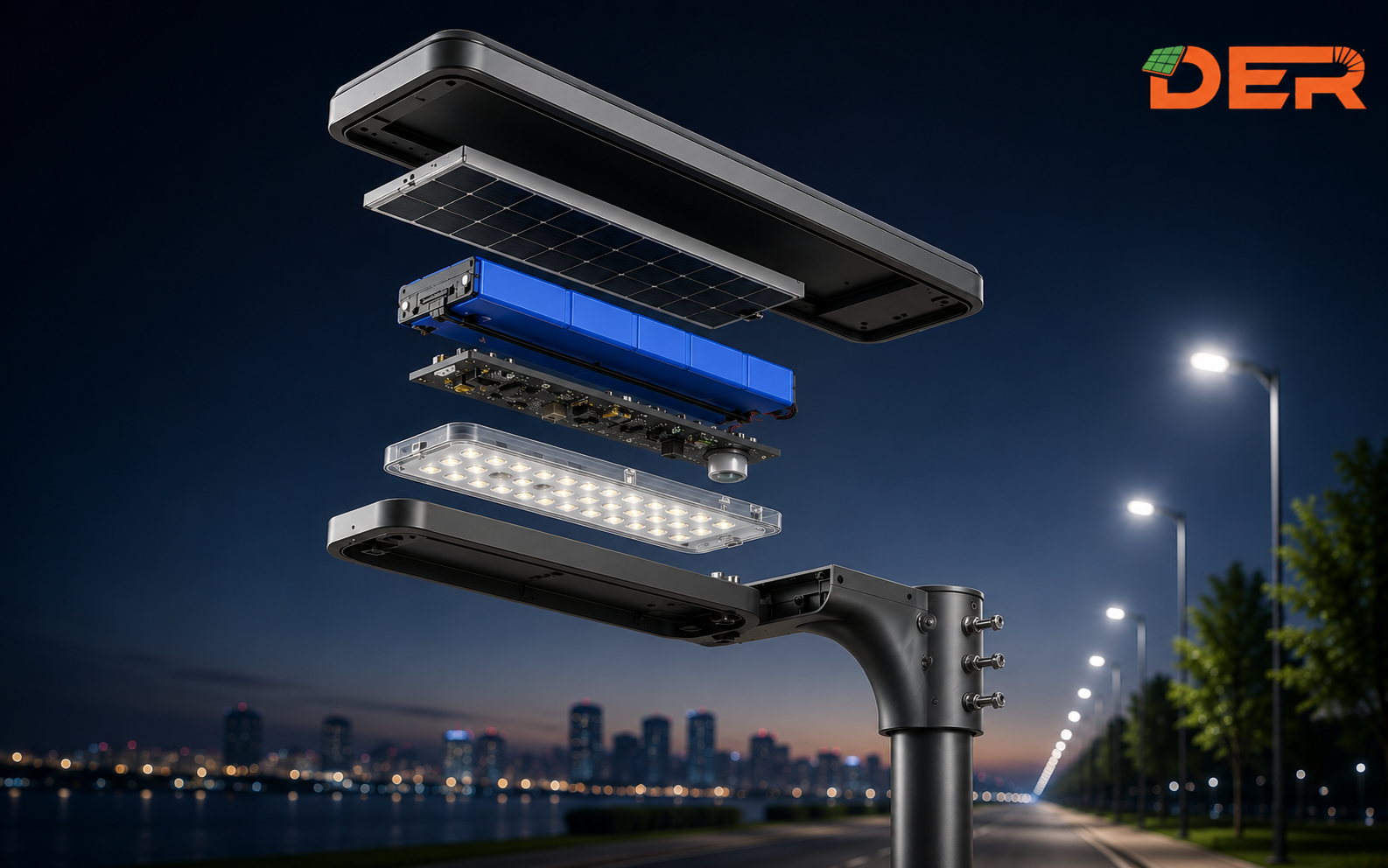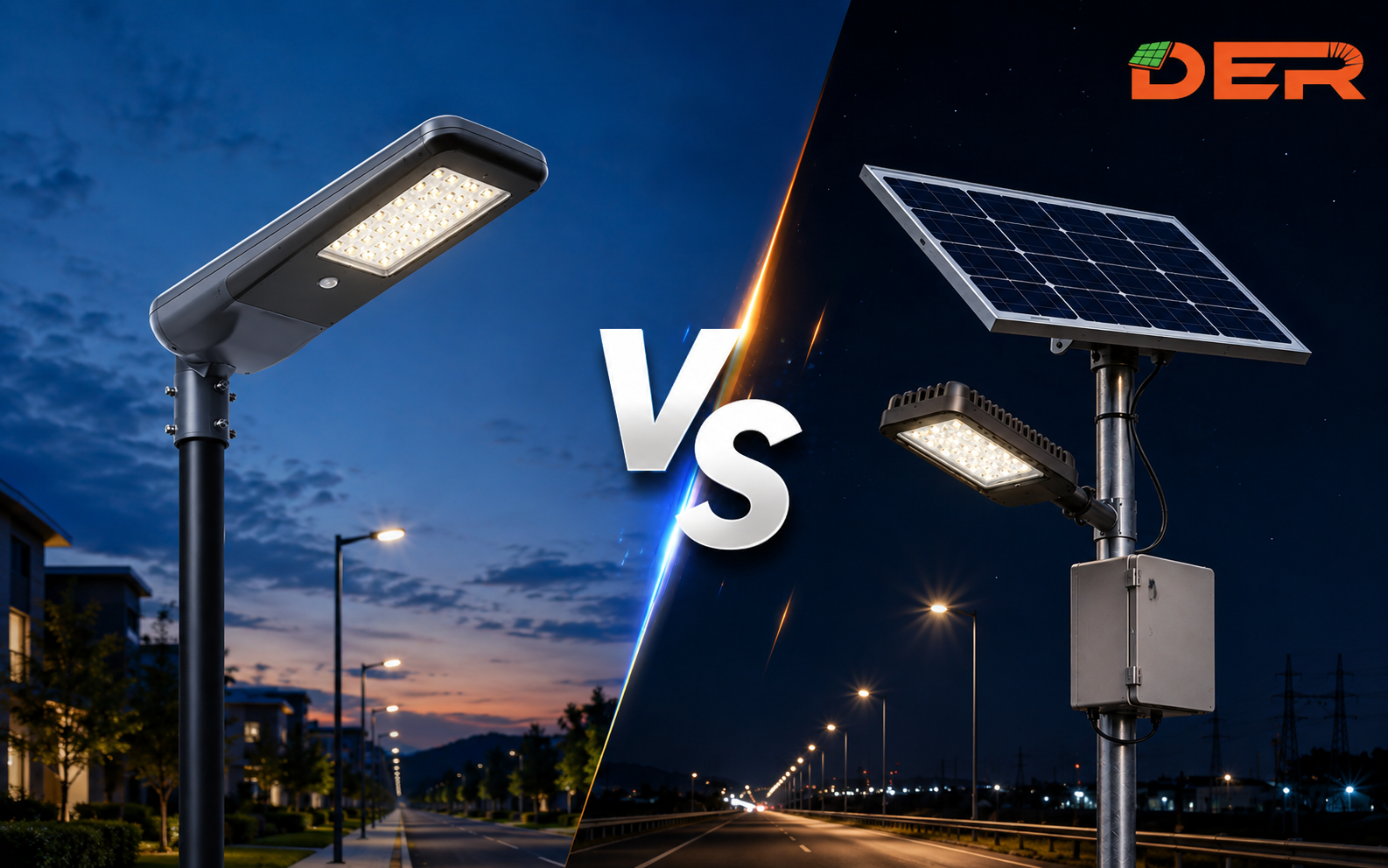
Lumens measure how much visible light a solar street light produces. Wattage measures how much electrical power it consumes. Brightness depends on more than either measurement alone.
It is also shaped by LED efficiency, optics, installation height, and the specific requirements of the application.
Buyers should evaluate the complete lighting system rather than relying on advertised wattage when comparing solar powered street lights.
Key Takeaways
- Lumens measure visible light output.
- Wattage measures electrical power consumption.
- Higher wattage does not always mean higher brightness.
- Luminous efficacy (lm/W) is a better indicator of LED efficiency.
- Lux, not lumens, is the measurement used for lighting design.
- Installation conditions significantly influence real-world brightness.
- Buyers should evaluate the complete lighting system rather than a single specification.
What Are Lumens in Solar Street Lights?
Lumens measure the total amount of visible light produced by a solar street light. A higher lumen rating generally indicates a brighter light. This makes lumens the primary measurement used to compare the lighting performance of different solar LED street light models.
Manufacturers publish lumen ratings because this figure reflects actual light output rather than power draw.
It is also important to distinguish between initial lumens and maintained lumens. Initial lumens measure the light output of a new fixture, while maintained lumens reflect its output after years of operation. Like all LEDs, solar street lights gradually experience lumen depreciation, meaning brightness slowly decreases over time.
This is often expressed through ratings such as L70, indicating the point at which the LEDs still produce 70% of their initial light output. For long-term outdoor installations, maintained lumens provide a more realistic measure of lighting performance than initial lumen ratings alone.
Lumens replaced wattage as the standard brightness indicator once LED technology made it possible for low-power fixtures to outperform older, high-wattage lighting. For anyone comparing outdoor solar street lights, the lumen rating is usually the first number worth checking.
What Is Wattage in a Solar Street Light?
Wattage measures how much electrical power an LED consumes. It does not measure how bright the fixture appears. In modern LED lighting, lower-wattage fixtures can often produce more light than higher-wattage models.
Traditional lighting technologies, such as incandescent or halogen lamps, used wattage as a rough proxy for brightness because their energy conversion was fairly consistent across products. LED technology broke that pattern.
Today, LED efficiency varies significantly between manufacturers, so two solar LED street light units with identical wattage can produce very different light output. This is why wattage no longer reliably predicts brightness in solar energy street lights.
What Is the Difference Between Lumens and Wattage?
Lumens measure light output, while wattage measures energy consumption. Comparing solar street lights by wattage alone can lead to inaccurate assumptions about brightness and efficiency.
| Feature | Lumens | Wattage |
| Measures | Light output | Energy consumption |
| Indicates | Brightness | Power usage |
| Higher value means | Brighter light | Higher electrical demand |
| Best used for | Comparing brightness | Estimating energy requirements |
For procurement teams sourcing commercial solar street lights, this distinction matters directly. Relying on wattage alone can lead to underestimating or overestimating the lighting performance a project actually needs.
Why Doesn’t Higher Wattage Always Mean a Brighter Solar Street Light?
Higher wattage does not necessarily produce higher brightness because LED efficiency varies between products. Two fixtures with the same wattage can deliver significantly different lumen outputs.
Several factors explain this gap:
- LED chip quality: Higher-grade LED chips convert electrical power into visible light more effectively than lower-grade chips.
- Driver efficiency: A poorly designed driver wastes electrical power as heat instead of converting it into light.
- Optical losses: Even a bright LED module can lose a portion of its output through inefficient lenses or reflectors.
- System design: The overall design of the LED array, heat dissipation, and circuitry all affect final light output.
For buyers evaluating a street solar led lights supplier, this means two products with the same wattage spec sheet can perform very differently in the field.
What Is Luminous Efficacy and Why Does It Matter?
Luminous efficacy measures how efficiently a light converts electrical power into visible light. It is expressed as lumens per watt (lm/W) and is one of the best indicators of lighting efficiency.
Typical LED efficacy ranges include:
- 100–120 lm/W: Older LED generations or lower-cost products.
- 140–180 lm/W: Modern commercial LED street lighting.
- 180–220+ lm/W: Premium LED packages designed for maximum efficiency and long service life.
Buyers should compare lm/W instead of wattage alone, because this figure reflects actual LED efficiency rather than power draw.
A solar street light with a lower wattage but a high lm/W rating can outperform a higher-wattage fixture with poor luminous efficacy. This is especially relevant for importers and distributors comparing supplier specifications across multiple solar street lighting brands.
Consider the following example:
| Fixture | Power Consumption | Luminous Efficacy | Total Light Output |
| Fixture A | 100 W | 150 lm/W | 15,000 lm |
| Fixture B | 120 W | 110 lm/W | 13,200 lm |
Although Fixture B consumes more electrical power, Fixture A actually produces more usable light because its LEDs convert electricity more efficiently. This illustrates why comparing wattage alone can lead to misleading conclusions.
What Determines the Actual Brightness of an All-in-One Solar Street Light?
Actual brightness depends on several factors beyond lumen output. These include optical design, mounting height, pole spacing, beam angle, and installation conditions.
The main factors include:
- LED chip efficiency: Determines how much of the consumed power converts into usable light.
- Optical lens design: Secondary optics shape and direct light output, affecting photometric distribution and coverage area.
- Beam angle: A narrower beam angle concentrates light over a smaller area, while a wider beam spread covers more ground at lower intensity.
- Mounting height: Taller pole heights spread light over a larger surface, which can lower the illuminance reaching the ground.
- Pole spacing: Wider pole spacing creates gaps in light distribution unless compensated by higher lumen output.
- Light distribution: Type II and Type III optics distribute light differently depending on road width and application.
- Ambient light: Existing light sources nearby can reduce the perceived brightness of a solar street light.
- Weather conditions: Fog, rain, and dust accumulation on the fixture can all reduce effective brightness on the ground.
Together, these factors explain why two solar street light installations with identical lumen ratings can look noticeably different in real-world use.
How Many Lumens Do Different Solar Street Lighting Applications Need?
The required lumen output depends on the application rather than a fixed wattage. Residential roads require less illumination than highways, ports, or airports.
| Application | Typical Lumen Range |
| Residential streets | 3,000–6,000 lm |
| Parking lots | 6,000–10,000 lm |
| Urban roads | 8,000–12,000 lm |
| Commercial areas | 10,000–15,000 lm |
| Industrial sites | 12,000–18,000 lm |
| Highways | 15,000–24,000 lm |
| Airports | 20,000–30,000 lm |
| Ports | 20,000–30,000 lm |
Actual requirements depend on the specific project design, including pole height, road width, and local illuminance standards.
These ranges offer a starting point for comparing solar street light pole options, but a photometric report is the more reliable way to confirm suitability for a given project.
Why Is Lux More Important Than Lumens for Lighting Design?
Lumens describe the total light emitted by a fixture, while lux measures how much of that light actually reaches a specific surface. Lighting standards are typically based on lux rather than lumens.
The relationship can be expressed simply:
Lux = Lumens ÷ Illuminated Area
This is why road surface illuminance, not raw lumen output, is the figure used in most lighting design standards.
Organizations that publish relevant illuminance standards include the Illuminating Engineering Society (IES), which maintains IESNA RP-8 for roadway lighting, the European standard EN 13201, and the International Electrotechnical Commission (IEC).
Procurement teams evaluating supplier specifications for commercial solar street lights should ask for lux-level data alongside lumen figures whenever possible.
How Do Installation Conditions Affect Brightness Requirements?
Identical street lights that are powered by solar can produce different lighting results depending on how and where they are installed.
Key installation factors include:
- Pole height and mounting height
- Pole spacing
- Road width
- Fixture orientation and installation angle
- Existing ambient light
- Trees and buildings that create shade
- Climate and seasonal variation
- Dust accumulation on the fixture
Each of these factors influences the lux level that actually reaches the road surface, independent of the fixture’s rated lumen output. A solar street light installed at the wrong height or angle can underperform its specification sheet, even if the LED module itself is high quality.
This is one reason photometric reports matter more than marketing claims when specifying a solar street light pole layout for a real project.
Can a Solar Street Light Have Too Many Lumens?
Yes. Excessive lumen output can create glare, increase energy consumption, reduce battery runtime, and contribute to unnecessary light pollution.
Oversized lighting creates several practical problems:
- Glare: Excess brightness can reduce driver visibility instead of improving it, especially when beam angle is poorly controlled.
- Pedestrian comfort: Overly bright fixtures can feel harsh rather than welcoming in residential or pathway settings.
- Battery runtime: Higher lumen output demands more energy per night, which can shorten battery autonomy during periods of low sunlight hours.
- Cost optimization: Oversizing a solar street light increases both installation cost and the size of solar panel and lithium battery required, without a proportional benefit in lighting performance.
For B2B buyers, matching lumen output to actual project specifications is usually more cost-effective than defaulting to the highest available rating.
What Common Mistakes Do Buyers Make When Comparing Solar Street Lights?
Many buyers compare products using advertised wattage alone, even though brightness depends on multiple technical factors.
Common mistakes include:
- Comparing wattage instead of lumens: This overlooks LED efficiency differences between suppliers.
- Ignoring luminous efficacy: A low lm/W rating signals a less efficient LED module, even if total wattage looks impressive.
- Ignoring beam distribution: A high lumen count means little if the beam pattern does not match the road width or application.
- Ignoring installation height: The same fixture can perform very differently at different pole heights.
- Ignoring battery capacity: A bright light with insufficient battery capacity will struggle to maintain dusk-to-dawn operation during cloudy weather.
- Ignoring runtime: Battery autonomy during consecutive cloudy days is as important as peak brightness.
- Ignoring project requirements: Applying highway-level lumens to a residential street wastes energy and budget.
- Trusting exaggerated wattage claims: Some suppliers inflate wattage figures without matching lumen output or photometric data.
For importers and distributors, avoiding these mistakes usually comes down to requesting a photometric report and supplier specifications rather than relying on a single number on a data sheet.
How Should Buyers Choose the Right Brightness for an All-in-One Solar Street Light?
The best approach is to begin with the application’s lighting requirements and then evaluate the complete system, rather than selecting a fixture based solely on wattage.
A practical process looks like this:
- Identify the application, such as a residential street, parking lot, or highway.
- Determine the required illuminance in lux based on relevant standards.
- Evaluate pole height and pole spacing for the specific site.
- Estimate the required lumen range based on the application table above.
- Compare luminous efficacy (lm/W) across supplier options.
- Review battery capacity, battery management system quality, and expected runtime.
- Consider local sunlight hours and seasonal variation in solar irradiation.
- Verify photometric data and, where possible, request a photometric report from the supplier.
For procurement managers, this process supports a stronger total cost of ownership calculation than comparing wattage or price alone. It also reduces the risk of specifying a solar street light pole system that underperforms once installed.
Need Help Choosing the Right Brightness for Your Project?
Selecting the right all-in-one solar street light involves more than comparing wattage or lumen ratings. Factors such as mounting height, beam distribution, battery capacity, local sunlight conditions, and photometric performance all influence real-world results.
At DER Lighting, we help distributors, importers, wholesalers, and project buyers evaluate the complete lighting system, not just the specifications on a datasheet.
Whether you’re comparing product options or planning a new project, our team can recommend the most suitable solution based on your application and performance requirements.
Contact us today to discuss your project or request technical specifications, photometric data, and expert guidance on selecting the right all-in-one solar street light.
Conclusion
Lumens measure light output, wattage measures power consumption, and brightness depends on the full lighting system rather than either figure alone. LED efficiency, optical design, mounting height, and installation conditions all shape how much usable light reaches the ground. Buyers sourcing solar street lights should evaluate luminous efficacy, lux-level data, battery capacity, and photometric reports together, rather than relying on wattage as a shortcut for brightness.
Frequently Asked Questions (FAQs):
Most outdoor solar lights fall between 1,000 and 6,000 lumens, depending on the area they cover. Larger spaces need higher output than small pathways or gardens.
The brightest solar street lights are usually industrial or highway-grade, reaching 20,000 to 30,000 lumens. These higher outputs are paired with stronger batteries to handle the extra power demand.
Lumens measure the total visible light output produced by a solar street light. They are the standard figures used to compare brightness between products.
Lumens measure light output. Watts measure electrical power consumption. A fixture can use less power and still produce more light if its LED efficiency is high.
No. Brightness depends on LED chip quality, driver efficiency, and optical design, not just wattage.
Ratings between 140 and 220 lm/W are considered efficient for modern LED street lighting, with higher-quality LEDs reaching the upper end of that range.
Lumens measure total light emitted by a fixture. Lux measures how much of that light actually reaches a given surface area.
Lumens, along with luminous efficacy and lux data, offer a more accurate basis for comparison than wattage alone.